Four Years After Spying, Barcelona Reopened the Òmnium Pegasus Case



Key Takeaways
- On May 6, 2026, Barcelona's Provincial Court (Fifth Section) ordered the reinstatement of a Pegasus espionage investigation involving three Òmnium Cultural members, reversing a February 2026 dismissal.
- The court found indications of unauthorized intervention on the three devices and noted that expert evidence does not point away from Spain's National Intelligence Centre (CNI) as a potential author.
- The ruling demands a petition to the Council of Ministers to declassify CNI documents related to the three individuals, a rogatory commission to Israel to request NSO Group records, and certified expert reports from three related Barcelona courts.
- Four years into Catalonia's Pegasus investigations, rights organization Irídia documented that Spanish courts failed to execute European Investigation Orders to Luxembourg on multiple occasions, allowing key lines of inquiry to expire without action.
The Surveillance That Launched a Thousand Closed Cases
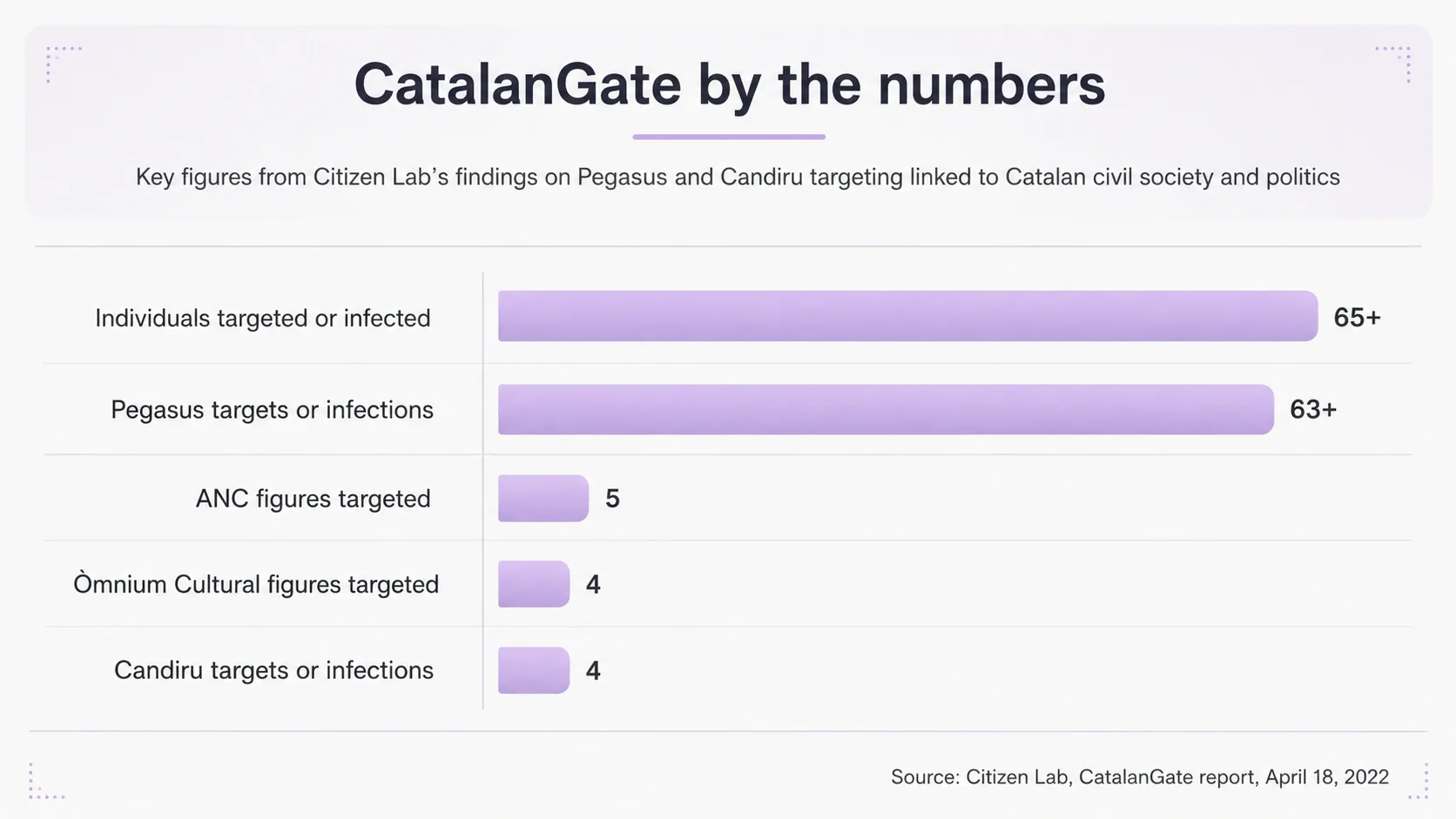
The Òmnium case is one fragment of a much larger investigation that has been visibly stalling for years. In April 2022, Citizen Lab's CatalanGate report identified at least 65 individuals linked to the Catalan independence movement as targeted or infected with Pegasus or Candiru spyware, including Members of the European Parliament, four Catalan presidents, legislators, lawyers, journalists, and civil society members, with strong circumstantial evidence pointing toward Spanish authorities.
Among those affected were three Òmnium Cultural members: former vice-president Marcel Mauri, international and legal head Elena Jiménez, and journalist Meritxell Bonet, the partner of Jordi Cuixart, who was Òmnium's president and on trial in the Supreme Court at the time. Their phones were allegedly surveilled between 2018 and 2020. Òmnium filed a formal complaint, and what followed was a process their lawyers eventually described as "fragmented, slow, re-victimizing, and without any concrete and real effect."
In February 2026, Investigating Court 21 of Barcelona provisionally dismissed the case, ruling that the crimes described could not be minimally justified given the difficulty of identifying who was responsible. Naturally, that difficulty had not grown any smaller as a result of anyone in the Spanish state cooperating with the investigation.
What the Fifth Section Actually Found
Òmnium, represented by lawyer Benet Salellas, appealed the dismissal, and the Fifth Section partially upheld it. The ruling found "indications of unauthorized intervention on the claimants' devices" and noted that expert evidence does not suggest anyone other than the CNI as a plausible author. That is a careful formulation, but a pointed one: a court has said, on the record, that the forensic evidence does not rule out Spain's own intelligence service.
The ruling orders a petition to the Council of Ministers to declassify CNI documents related to the three individuals, a rogatory commission to Israel requesting NSO Group records on Pegasus use against their devices, and certified expert reports from three related Barcelona courts handling analogous cases at a more advanced stage.
NSO Group was not formally named as a criminal suspect, with the court citing insufficient indicia, though the rogatory commission keeps that door open. Òmnium's president, Xavier Antich, called it "the least the justice system should do."
The Investigation That Spain's Courts Let Die Quietly
The reopening matters. And yet the system that produced it has also been dismantling the kind of investigation the Fifth Section is now asking for. In March 2026, Irídia – Centre for the Defense of Human Rights documented that Spanish courts had repeatedly failed to execute European Investigation Orders to Luxembourg, where NSO Group's corporate entities operate. Luxembourg authorities requested responses up to six times before closing the orders without execution, and in at least one case Spain sent the order two years late.
European Investigation Orders are the only mechanism to compel NSO Group to produce documentation, and their failure means the investigation cannot reach the companies most likely to hold the evidence. But what the Irídia-led case demonstrates is that outcomes are possible when courts pursue them.
In July 2025, a Catalan court formally charged former CNI director Paz Esteban and three NSO Group executives over the alleged Pegasus surveillance of lawyer Andreu Van den Eynde, the first time a former intelligence chief and NSO officials faced criminal investigation in the same case.
The pattern of surveillance targeting journalists and civil society runs across Europe, but no government has yet faced meaningful consequences for it, and Spain stands out for the documented scale of its victims and the consistency with which its institutions have avoided confronting what that documentation shows.
The Fifth Section's ruling is a more honest reading of the evidence than Court 21 managed, and naming the CNI as an entity the forensics do not clear is the correct response to what was submitted. And yet a court ordering declassification is a request, not a compulsion.
Spain's government has years of practice deciding what to do with such requests. The answer has been consistent. Mauri, Jiménez, and Bonet were surveilled between 2018 and 2020. It is 2026 now, and Spain has many more tools for delay than Barcelona has courts willing to push back, yet the government has shown no indication it intends to treat this ruling differently than every other demand in the case. I think that alone says enough.


Be part of the resistance, quietly.
Get Mysterium VPN
Dominykas is a technical writer with a mission to bring you information that will help you keep your digital privacy and security protected at all times. If there's knowledge that can help keep you safe online, Dominykas will be there to cover it.
Related Articles
.png)