Estonia Rejects EU Social Media Ban, Says Brussels Should Be Targeting Big Tech


Key Takeaways
- The European Parliament passed a non-binding resolution in November 2025 calling for an EU-wide minimum age of 16 for social media access, with parental consent allowed from 13.
- Estonia's Justice and Digital Affairs Minister Liisa Pakosta rejected the approach, saying blanket age verification is easily bypassed and the focus should be on enforcing existing EU law.
- Estonia and Belgium were the only two EU member states to decline the Jutland Declaration, a pan-European commitment signed in October 2025 to restrict children's access to social media.
- Despite domestic pressure from opposition politicians, the Estonian government held its position that platforms must be held accountable, not young people locked out.
The Law That Already Exists, and Nobody Enforces
The European Parliament voted in November 2025 to call for a unified EU minimum age of 16 for social media, passing the non-binding resolution 483 to 92 with 86 abstentions. The proposal would allow 13- to 15-year-olds access with parental consent and apply across social media, video-sharing platforms, and AI companions, drawing political momentum from Australia's under-16 ban and a continent increasingly convinced it wants something similar.
Estonia looked at all of that and said no. Justice and Digital Affairs Minister Liisa Pakosta argued that Europe has already imposed clear and strict requirements on social media platforms specifically to protect children and that the problem is enforcement, not legislation.
The truth is that the rules exist – platforms just aren't following them, and adding a new age limit on top of unenforced law doesn't fix the underlying failure. What it does is it lets governments pretend they’re doing something instead of, you know, actually doing it. This pattern of piling age verification laws everywhere while existing protections go unexamined is exactly how we got here.
Estonia and Belgium were the only two EU member states to decline the Jutland Declaration, signed in October 2025 by 25 of 27 member states along with Norway and Iceland, committing to privacy-preserving age verification and restricting children's access to addictive design features. Estonia's refusal wasn't procedural dissent. It was a principled argument about where the regulatory effort should actually go.
The Bypass Is Already in the Patch Notes
Pakosta was unambiguous on this point. Young people can easily get around blanket age verification – it’s a documented fact. Australia's ban proved it within weeks of taking effect in December 2025, with seven in ten children who previously held social media accounts still active after the ban. VPNs, false birth dates, and borrowed adult credentials required no technical sophistication and were widely adopted before anyone in government finished congratulating themselves.
The politician also flagged a second problem that tends to get less attention. If platforms turn to behavioral analysis or language pattern detection as an alternative to ID checks, the system produces inaccurate results and ends up profiling every user, including the children it was meant to protect. You wanted to keep kids safe, and you built a behavioral surveillance layer instead. Naturally, nobody in the press release mentioned that part because that’s not what the social media advocates want to hear.
The enforcement gap Pakosta describes is the predictable outcome every time a government skips platform accountability and reaches for access restriction instead. The EU's own Digital Services Act already requires the largest platforms to implement protections for minors. According to Estonia's position, as reported by Politico, those requirements are going unmet, and nobody is seriously pushing consequences.
Accountability Without a Convenient Target
The domestic pressure on Pakosta was real. Madis Kallas of the Social Democratic Party, who helped initiate a parliamentary inquiry on the issue, said the government wasn't treating the problem seriously enough and called for new forms of intervention. MEP Jüri Ratas voted against the EU proposal but pivoted toward education rather than platform accountability, arguing that rules without enforcement mechanisms produce nothing worth enforcing.
The disagreement inside Estonia actually clarifies the argument. Everyone agrees the status quo is failing. The split is over who bears responsibility for fixing it. Kallas wants EU-coordinated action, which is fair, but the question is what that action should be. Pakosta and Estonia's full government position, along with Kristina Kallas' LinkedIn post on Big Tech regulation, make clear the answer should be directed at platforms, not at the age printed on a user's profile.
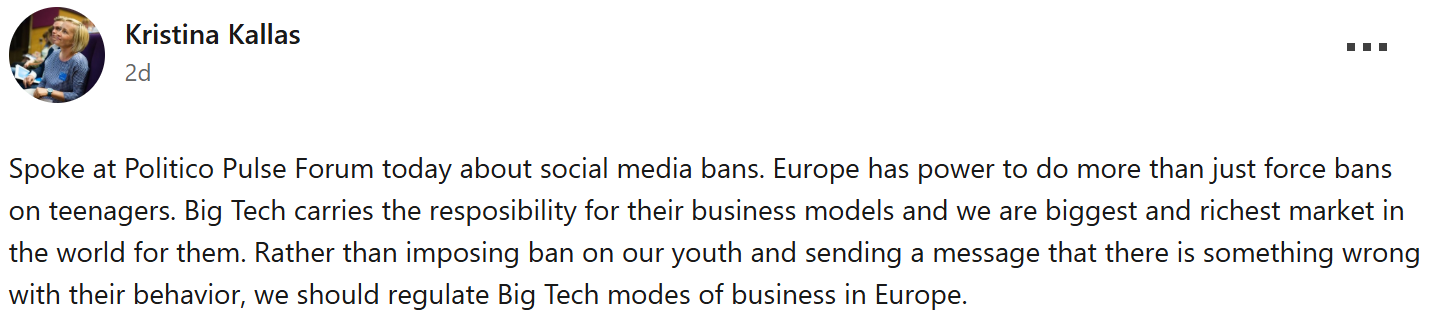
I think Estonia is right, even if it's the harder position to hold politically. A ban gives governments a visible action with a clear date. Demanding that the European Commission enforce the DSA against Meta and TikTok requires sustained political will and a willingness to name the companies failing and fine them accordingly. One of those is much easier to announce at a press conference.
And yet the more important question goes unasked. If platforms have been violating the DSA's existing minor protection provisions for years, what exactly is the theory of change that makes them comply with stricter rules? The ban model assumes the problem is insufficient restriction. Estonia's model assumes the problem is insufficient consequences. Only one of those assumptions has any evidence behind it.
If the EU is serious about protecting children online, it should explain publicly which platforms have faced meaningful penalties under existing law for failing to protect minors and what those penalties were. Because if the answer is none, then the conversation about raising the age limit is a distraction from the one nobody wants to have.


Be part of the resistance, quietly.
Get Mysterium VPN
Dominykas is a technical writer with a mission to bring you information that will help you keep your digital privacy and security protected at all times. If there's knowledge that can help keep you safe online, Dominykas will be there to cover it.
Related Articles
.png)