Language Is the Internet Freedom Problem Nobody Discusses


Key Takeaways
- Not every internet freedom problem looks like a ban. When your language barely exists online, the exclusion is just as real.
- Content moderation systems are built around English. In places like Myanmar, that failure contributed to documented mass violence.
- AI models trained mostly on English data perform worse for the rest of the world, creating a two-tier experience by default.
- UNESCO estimates there are over 7,000 languages. The internet serves a small fraction of them with anything close to equality.
Today, July 7th, is World Kiswahili Language Day, recognized by UNESCO to honor one of Africa's most widely spoken languages with over 200 million speakers across East Africa and beyond. This year, UNESCO marked the occasion with the launch of an English-Kiswahili AI dictionary, which is a meaningful and practical step toward making the language more visible in digital spaces.
I mention this not to celebrate it as a solved problem but as a useful reminder of how much work it takes just to give one language a foothold online. Kiswahili is comparatively well-positioned. It has official status across multiple countries and at the African Union. People are building tools around it. Most of the world's languages are nowhere near that position, and even for Kiswahili, existing on the internet is not the same as being safe on it or treated equally within it.
I want to use today as a reason to talk about a version of internet inequality that gets much less attention than censorship or access gaps. It is this: if you live your life in a language the internet doesn't understand, you are not just underserved. You are often unprotected.
When Your Language Barely Exists Online
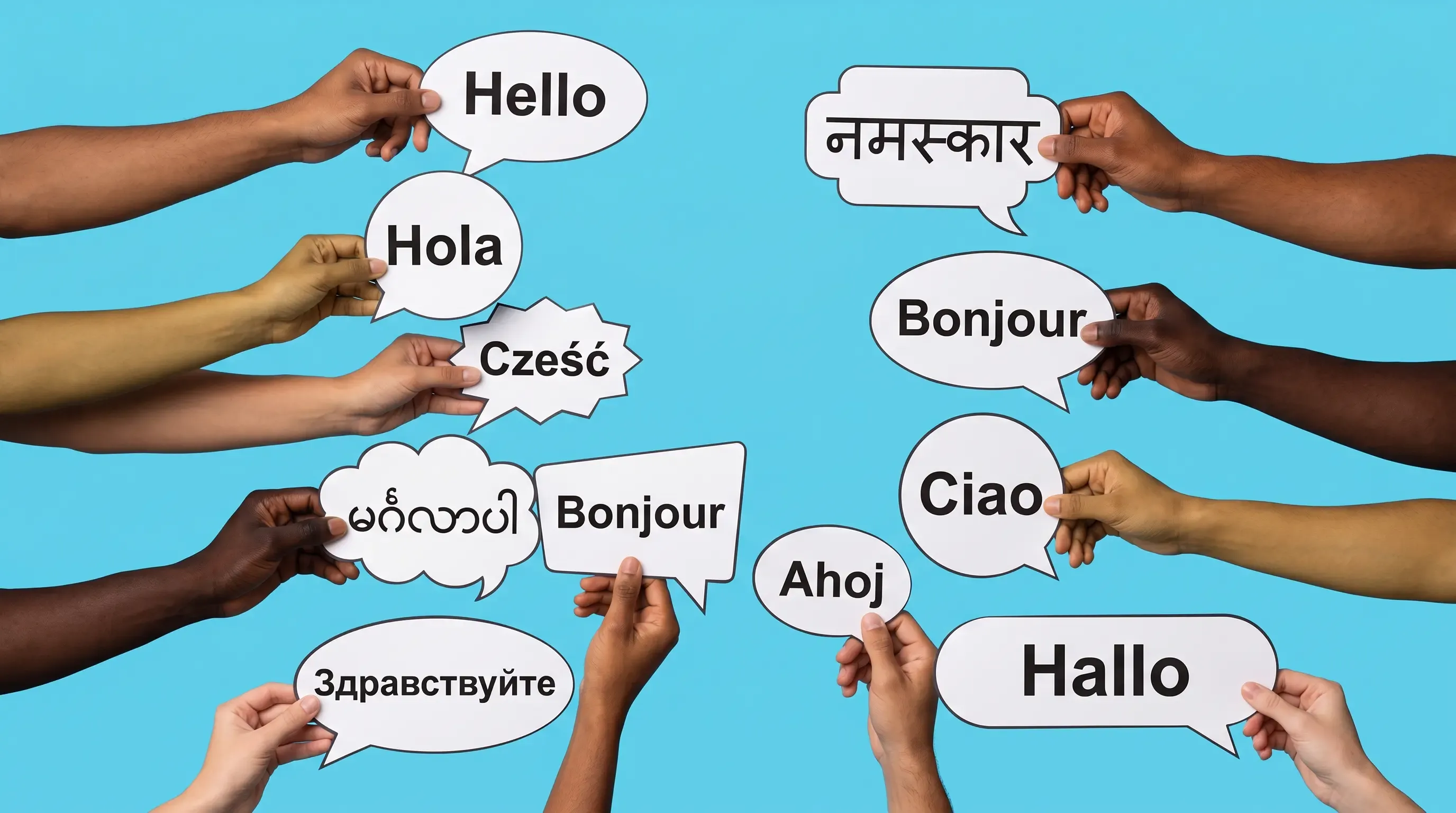
The internet has a dominant language. English accounts for a majority of all web content by most estimates, while billions of people don't use English as a primary language at all. The consequences of this go well beyond inconvenience. When there is very little content in your language, search results are sparse and unreliable. When your language has very little training data, AI tools perform badly or inconsistently in it. When platforms were designed without your language in mind, the tools that are supposed to keep you safe and informed don't work for you the way they work for an English speaker.
UNESCO's Global Roadmap for Multilingualism in the Digital Era addresses this directly, calling for digital content, platforms, and tools to be built in ways that genuinely include the world's languages, not only its most commercially valuable ones. The framing in that roadmap matters: this isn't a niche accessibility issue. It is a question of who gets to participate in public life, who can seek and share information without barriers, and for whom the infrastructure of the modern internet was actually designed. Right now, the honest answer to that last question is: mostly people who read and write in English.
Moderation Can’t Read Your Post
The most dangerous version of this problem is not about search rankings. It is about what happens when content moderation systems can't read what is being posted.
The clearest case study is Myanmar. When Facebook became the dominant way most people in the country accessed the internet in the mid-2010s, the platform became a vehicle for coordinated anti-Rohingya hate speech and disinformation on a massive scale. The content was explicit, violent, and specifically designed to incite. The problem was that Facebook had almost no Burmese-speaking moderators.
In 2018, a UN fact-finding mission on the Rohingya crisis concluded that Facebook had played a "determining role" in spreading the kind of incitement that preceded and accompanied the violence. John Oliver's 2018 Last Week Tonight segment covering Facebook's moderation failures in Myanmar, the Philippines, Cambodia, Sri Lanka, and India documented how the platform had virtually no moderators who spoke the relevant local languages, meaning genuinely threatening content circulated freely while harmful misinformation reached millions without any meaningful review.
Oliver returned to the same structural failure in 2021, documenting how Facebook's content review for non-English languages, including Hindi and Spanish, was a fraction of what it applied to equivalent English content.
I want to be precise here. I am not arguing that platforms are malicious toward non-English speakers. I am arguing that they were built with English as the default assumption, and that when you build safety infrastructure around a default assumption, everyone outside that assumption gets a worse product. In the case of content moderation, a worse product can mean people get killed.
AI Inherits the Same Gaps
The problem extends into the current AI era. Large language models are trained on datasets drawn from the internet, and those datasets reflect the internet's existing skews. A model trained mostly on English text performs better in English. It generates more accurate outputs, understands more nuance, and catches more errors when working in English than when working in Yoruba, Quechua, or Tibetan.
This creates a feedback loop that is hard to break. Languages with small digital footprints produce less training data, so AI tools work worse in those languages, so people who speak them get less value from AI-powered tools, so less digital content gets created in those languages, and the gap compounds.
UNESCO identifies the digital space as a key battleground for language survival, noting that a language that disappears from the internet doesn't just lose access to one platform. It loses access to the infrastructure through which modern public life is increasingly organized, from health information to legal resources to news.
The people most at risk from this are already among the world's most marginalized communities. That is not a coincidence. It is a pattern.
A Free Internet Has to Be Free for Everyone
We tend to think about internet freedom in terms of what governments and corporations do to block it: bans, surveillance, content takedowns. But the Myanmar case, the AI gap, and the moderation disparity in Hindi and Spanish are reminders that a free internet can fail people who were never explicitly targeted. Nobody banned Burmese users from Facebook. Nobody made a deliberate decision to leave Hindi misinformation up. The harm came from systems built as if those users didn't fully exist.
That is a different kind of unfreedom, but it’s there. Freedom of expression means very little if the infrastructure you're expressing yourself on doesn't understand you, doesn't protect you, and doesn't apply its own rules to your content the same way it applies them to an English-language equivalent. People have a right to access the internet in their own language, to have that presence taken seriously, and to receive the same basic protections that speakers of dominant languages receive as a baseline.
World Kiswahili Language Day is a small but meaningful occasion. An AI dictionary for one language is a genuine step. But the problem is global, the stakes are high, and the fix requires treating language equity as a key part of internet freedom, not a feature to be added later when we have some free time. We usually don’t. And people pay for that in ways that English-speaking audiences rarely see.


Be part of the resistance, quietly.
Get Mysterium VPN
Gintarė is a cybersecurity writer at Mysterium VPN, where she explores online privacy, VPN technology, and the latest digital threats in editorial pieces. With hands-on experience researching and writing about data protection and digital freedom, Gintarė makes complex security topics accessible and actionable.
Related Articles
.png)