Lithuania Moves to Politicize Its National Broadcaster Amid Mass Protests


Key Takeaways
- Lithuania's ruling coalition has been pushing to reshape the governance of national broadcaster LRT since late 2025, using a politically motivated audit as the pretext.
- The original proposals would make it easier to fire the LRT director general; the revised version goes further, expanding political representation on the supervisory council and granting it powers that legal experts say amount to editorial censorship.
- The reform process was captured by coalition-aligned MPs after opposition members and journalists' associations boycotted the working group, calling it a sham.
- International bodies, including the Venice Commission and the European Broadcasting Union, have warned the proposals risk politicization and may violate EU media law, with over ten thousand people having twice protested in Vilnius.
- Despite mass protests on April 8 and several similar protests before them, politicians have publicly vowed not to back down, and the amendments are expected to pass before the end of the spring parliamentary session.
How a Governance Tweak Became a Bid for Editorial Control
The campaign against LRT, which people in Lithuania flooded the streets to protest on April 8, first started in late November 2025. Nemunas Dawn, the populist party inside Lithuania's governing coalition (whose leader was found guilty of antisemitic hate speech and downplaying Nazi crimes, by the way), pushed through a budget freeze, fixing the national broadcaster's annual funding at €79.6 million through 2028. This bypassed the automatic funding increase mechanism entirely and was done without consulting LRT management.
Simultaneously, the party introduced a bill lowering the threshold to dismiss the LRT director general from a two-thirds majority to a simple majority on the 12-member supervisory council. The pretext was a politically commissioned audit of LRT's "political neutrality." The audit found no editorial bias, but the coalition pressed ahead anyway.
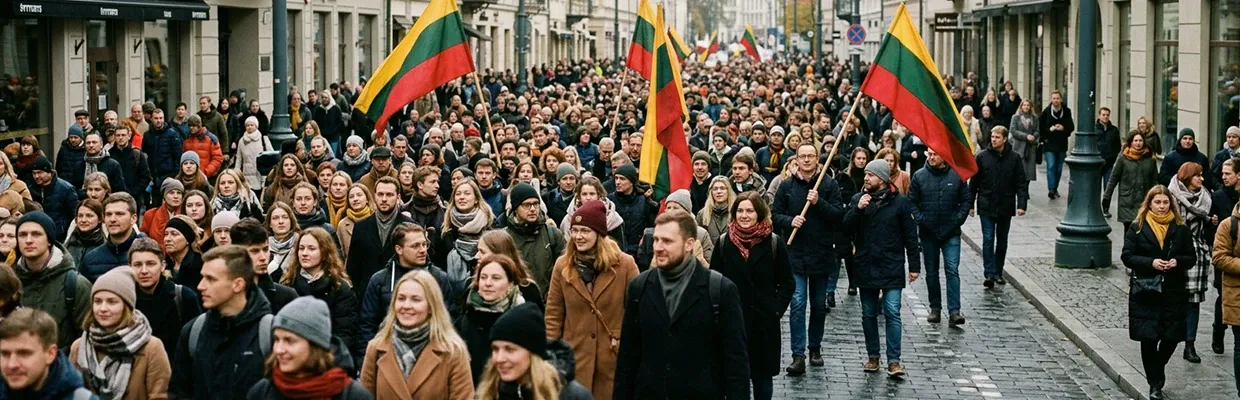
LRT journalists launched a protest campaign in response. On December 9, 2025, over ten thousand people gathered outside the Seimas in Vilnius, one of the largest demonstrations in years, with more than 143,000 people signing a petition. The Seimas tried to fast-track the bill under an expedited procedure, drawing criticism from the opposition, the Venice Commission, the European Broadcasting Union, the European Council, and Lithuania's own parliamentary legal department. The coalition paused and set up a working group to revise the proposals. Then it stacked the group with its own MPs.
Opposition members left the working group almost immediately, calling it a sham. The Association of Professional Journalists, which had organized the protests, left too. In solidarity, the protest committee formed by LRT staff announced its boycott as well. Yet, what the coalition-dominated group produced was significantly more expansive than the original bill.
The supervisory council would grow from 12 to 15 members, with the addition of a delegate from the Tripartite Council, a body that includes government representatives. LRT would be restricted from collaborating on content with other media organizations. And the council would gain powers over programming broad enough that law professor Toma Birmontienė, who reviewed the proposals for parliament, concluded they constitute censorship in practice.
The Hungarian Warning, Delivered in Person
The clearest illustration of where Lithuania's road leads showed up at the April 8 rally itself. Hungarian investigative journalist Szabolcs Panyi flew to Vilnius to address the crowd in person. He told the protesters that this is exactly how Viktor Orbán began attacking Hungarian media after coming to power in 2010 and that it started with public radio.
The parallel is worth spelling out. In Hungary, Orbán's first moves against public media were framed as administrative modernization: governance restructuring, budget controls, and adjustments to supervisory appointments. Within a few years, Hungarian public broadcasting had become a state mouthpiece, while independent outlets faced advertising starvation, hostile ownership transfers, and sustained regulatory pressure.
What remained of independent journalism got increasingly criminalized. Panyi himself now faces espionage charges from the Orbán government for reporting on Russian influence operations inside the Hungarian state. The journalist who stood in Vilnius warning Lithuanians where this path leads is, himself, the destination.
Lithuania is at the governance-restructuring stage. The budget freeze, the lowered dismissal threshold, the expanded council, and the content restrictions. The working group that excluded everyone who disagreed and still called itself a consultative process. The gap between where Hungary was in 2010 and where it is now closed faster than most people expected.
Over Ten Thousand People in the Street Once Again, and a Government That Still Isn't Listening
On April 8, 2026, the "Hands Off Free Speech" rally drew over ten thousand people to Independence Square outside the Seimas. Journalists, comedians, artists, and activists turned up alongside Panyi. Birutė Davidonytė, chair of the Association of Professional Journalists, told the crowd that experts have already stated the law could constitute censorship prohibited by the Constitution and that politicians would control what people see and hear.
This was not the first time these people had stood in that square. The December 9 rally drew the same crowd. The difference is that this time they came back after the working group had produced something worse than the bill that drove them out in the first place.
Seimas Speaker Juozas Olekas responded the following day. The coalition would not back down, he said, and the amendments would be adopted during the spring session. "We will do what needs to be done and change what needs to be changed. We will talk to those willing to talk, not those who crookedly show the middle finger."
Foreign Minister Kęstutis Budrys offered a more diplomatic line, saying the Venice Commission conclusions must be taken into account and that Lithuania cannot afford to raise doubts about its democratic process or media freedom. Those two positions, issued on the same day from within the same government, do not reconcile.
Lithuania has consistently ranked well on press freedom indices. Those rankings reflect real institutional choices. Choosing to stack a working group, ignore a Venice Commission warning, dismiss a joint letter from eight European public broadcasters, including the BBC, and tell protesters to mind their gestures are also institutional choices.
Panyi watched his country make the same ones. He was in Vilnius this week because he knows exactly what comes next, and he wanted Lithuanians to know it too. The question is whether the people on the street can make the parliament listen before the spring session ends.


Be part of the resistance, quietly.
Get Mysterium VPN
Dominykas is a technical writer with a mission to bring you information that will help you keep your digital privacy and security protected at all times. If there's knowledge that can help keep you safe online, Dominykas will be there to cover it.
Related Articles
.png)