Microsoft's Own Investigation Caught Its Israeli Branch Spying on Palestinians



Key Takeaways
- Microsoft Israel's country general manager Alon Haimovich departed last week following an internal investigation by Microsoft's global management team, after four years in the role.
- The investigation found that Azure was used by units of Israel's Ministry of Defense for mass surveillance of Palestinian phone calls, violating Microsoft's terms of use and creating regulatory exposure in Europe.
- Several governance department managers also left alongside Haimovich, and Microsoft Israel now temporarily reports to Microsoft France.
- Microsoft had already terminated IDF intelligence Unit 8200's access to Azure in September 2025, after The Guardian first reported on the surveillance use, but the probe found Unit 8200 was only part of a broader pattern.
- The departures come as Microsoft's Ministry of Defense contract is due for renewal at the end of 2025, with both parties still reportedly interested in continuing on a reduced scale.
The Probe That Went Further Than the Press Release
Microsoft has spent years building a public privacy identity around Brad Smith, invoking "protecting privacy and preventing mass surveillance" as guiding principles. Microsoft's own investigation found something that puts a different frame on that. Alon Haimovich, the country general manager at Microsoft Israel, stepped down last week following an internal probe that found Azure had been used by units of Israel's Ministry of Defense for mass surveillance of Palestinian phone calls, violating Microsoft's terms of use and exposing the company to regulatory risk in Europe.
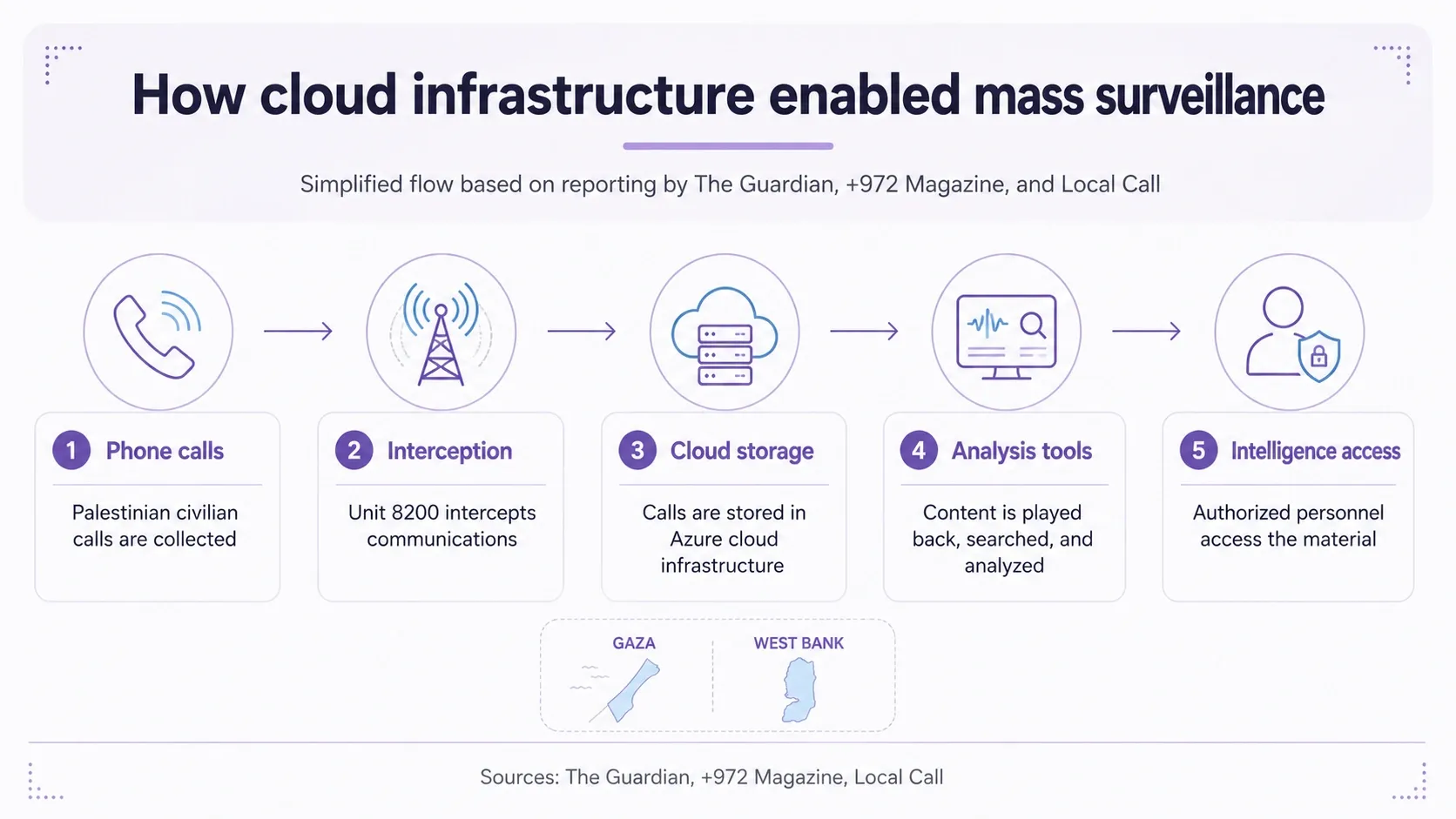
IDF intelligence Unit 8200's Azure access had already been terminated in September 2025, after The Guardian reported that the unit was storing recordings of Palestinian phone calls on Azure servers on European soil, with Microsoft finding supporting evidence and Smith announcing an investigation.
And yet, what that investigation found was that Unit 8200 was the visible part, not the whole picture. Additional Ministry of Defense units were operating Azure in non-transparent ways, unknown to Microsoft's global management, in violation of the company's terms of use, with Haimovich summoned to the investigative committee over a claim that Israel's management had not conducted itself with full transparency regarding how the Ministry of Defense was using Microsoft's systems.
Several managers in Microsoft Israel's governance department also departed alongside Haimovich, and the branch, until now subordinate to regional management in Dubai, has been transferred to operate under Microsoft France. +972 Magazine had previously reported on the scope of Azure's entanglement with Palestinian surveillance, and the investigation confirmed the problem ran considerably deeper than a single unit's contract.
How Azure Ended Up Inside a Surveillance Operation
Microsoft is the only major cloud provider that did not sign the Nimbus cloud tender in 2021, meaning it never agreed to the same military data collection permissions that Google and Amazon built into their agreements when they won the tender. That structural absence meant Microsoft carried something that looked like ethical flexibility but was, structurally, legal vulnerability.
Nimbus franchisees have contractual protections that make unilateral termination difficult, and Microsoft does not. Part of the Ministry of Defense's Azure use, according to The Guardian's original August 2025 reporting, ran through servers on European soil, where GDPR creates genuine exposure. Haimovich was appointed in part to retain and grow Ministry of Defense business despite Microsoft losing Nimbus, and the investigation found that drive had costs global management apparently didn't know about.
The ethics code failed, and it likely did so because growing defense revenue was the objective, and the ethics framework was what got managed around it, which is exactly the pattern documented in “no accountability for surveillance" operations everywhere, where vendors and local teams absorb consequences and institutions continue undisturbed.
Accountability That Ends With a Resignation Letter
The accountability is superficial as ever: a country general manager left, some governance managers left, and the branch changed reporting lines. The Ministry of Defense contract is still being renewed, with defense computing units having already shifted significant cloud infrastructure to Amazon and Google, and both parties reportedly still interested in continuing on a reduced scale. This sits precisely within the broader pattern of information suppression in Palestine, where the tools doing the work change but the structure remains intact.
The pressure that preceded all of this was not small. Around 15,000 current and former employees protested at Microsoft's May 2025 developer conference under the "No Azure for Apartheid" banner, with two employees fired after breaking into Brad Smith's office and Arkane Studio's union publishing an open letter calling Microsoft complicit in a genocide. Norway's sovereign wealth fund raised a December 2025 shareholder proposal requiring a human rights risk report, without naming Israel, because apparently that's how you raise the issue these days. None of it produced a contract termination. It produced an investigation, and the investigation produced a resignation.
Microsoft is now presenting Haimovich's departure as a resolution. But the Ministry of Defense contract is still active, the investigation's findings about non-transparent use across multiple units produced exactly one personnel change, and Brad Smith's "protecting privacy and preventing mass surveillance" principle has apparently been applied in this country for two decades as well. If that principle is real, the question is why a probe confirming mass surveillance concluded with a resignation and not a contract termination. They had everything they needed to act. They chose what to do with it.


Be part of the resistance, quietly.
Get Mysterium VPN
Dominykas is a technical writer with a mission to bring you information that will help you keep your digital privacy and security protected at all times. If there's knowledge that can help keep you safe online, Dominykas will be there to cover it.
Related Articles
.png)