PlayStation Rolls Out Age Verification in UK and Ireland With No Announcement



Key Takeaways
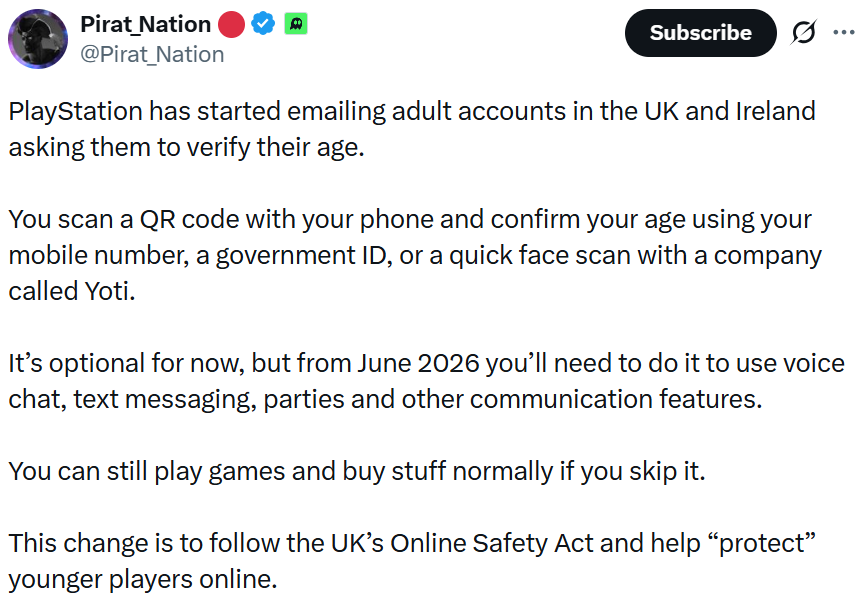
- Sony began rolling out age verification for PlayStation accounts in the UK and Ireland with no formal press release, announcing it only through a quietly updated FAQ page and an email to existing users.
- From June 2026, adult accounts that haven't verified their age will lose access to voice chat, text messaging, party features, broadcasting, and certain in-game communication tools.
- Games, trophies, and the PlayStation Store are not affected, with only the social layer gated behind the check.
- Verification is handled by Yoti, a third-party provider already fined roughly €950,000 by Spain's data protection authority for mishandling biometric data.
- Sony has stated plans for a global rollout beyond the UK and Ireland, making this the beginning of a pattern rather than a one-off regional measure.
An Email and an FAQ: Sony's Entire Announcement Strategy
Sony began emailing adult PlayStation accounts in the UK and Ireland this week about mandatory age verification arriving in June 2026. And, of course, as is the current trend with such unpopular updates, there was no press conference, no blog post, and no official announcement on PlayStation's social channels. The only documentation Sony put out was a support FAQ page that went live quietly and an email to users containing a QR code.
That QR code, as users quickly discovered, links to Sony's verification flow via a company called Yoti. Adult accounts can verify using a mobile number, a government-issued ID, or a facial scan, with Yoti estimating your age from a photo of your face.
The deadline is June 2026. Until then, everything on PlayStation still works as normal. After that, players who haven't verified will find voice chat, text messaging, party features, broadcasting, and certain in-game communication tools locked. Games, trophies, and PlayStation Store purchases are unaffected, at least for now.
What Handing Over a Face Scan Actually Means
The three verification options Sony offers through Yoti aren't equally invasive, but none of them are nothing. Mobile number verification matches your phone contract details. ID verification requires a photo of your passport, driving license, or national ID. The facial scan option uses Yoti's proprietary technology to estimate your age from your face's geometry, which Yoti says is deleted immediately once processing is complete. But we’ve heard that one before, haven’t we?
That deletion claim becomes more interesting when you know Yoti's regulatory history. In early 2026, Spain's data protection authority fined Yoti approximately €950,000 for storing facial scan images longer than promised and for failing to obtain valid consent for processing biometric data. Security researchers have also flagged that Yoti's app transmits device-level identifiers to third-party trackers without clear prior consent.
Sony's position is that it receives only a verification result from Yoti, not the biometric data itself. That may be technically accurate. It also means Sony is running millions of users' faces through a company that has already been formally sanctioned for misusing exactly this kind of data.
The Law Behind This and Where It Goes From Here
Sony isn't acting on its own initiative. The UK Online Safety Act 2023 came fully into enforcement on 25 July 2025, requiring platforms hosting user-generated content and communication features to implement age assurance measures. Ofcom, the regulator overseeing compliance, has already opened investigations into more than 90 services and issued multiple fines for non-compliance. Sony's June 2026 deadline maps directly onto those compliance timelines.
And, of course, none of this pattern is unique to PlayStation either. Ubisoft started sneakily age-gating in-game chats in response to similar regulatory pressure. Discord rolled out age verification last year and then walked parts of it back in early 2026 after significant user pushback over privacy. Roblox implemented age checks in January. Each rollout follows the same script, with a compliance framing, a third-party verification partner, and a feature restriction as the enforcement mechanism.
What makes Sony's situation different is scale and trajectory. A report from Gamespot cites an email from Sony Interactive Entertainment referencing a global age verification rollout planned for later this year, driven by laws like California's Digital Age Assurance Act taking effect in January 2027. So, in other words, the UK and Ireland rollout is just the pilot.
Compliance Is the Point, and the Infrastructure Is the Risk
Sony describes age verification as a way to deliver the "best PlayStation experience for your age" and to "protect younger users." The UK government frames the Online Safety Act as a child safety measure. The concrete output of both positions is a biometric data pipeline run by a company with an active regulatory violation on its record, collecting face scans and ID documents from millions of adult gamers who just want to use voice chat.
But with the censorship trajectory Sony is on, things are more alarming that they might seem at first glance. There was not any single policy change, but the cumulative normalization of ID-and-face-scan requirements for access to features that previously required nothing is not at all a good sign.
Sony will only extend this, and that much is clear, but the real question is whether any of the governments mandating this have seriously considered what happens when Yoti, or whoever replaces Yoti, experiences a real breach. Because right now, the answer these laws provide is a shrug and a fine.


Be part of the resistance, quietly.
Get Mysterium VPN
Dominykas is a technical writer with a mission to bring you information that will help you keep your digital privacy and security protected at all times. If there's knowledge that can help keep you safe online, Dominykas will be there to cover it.
Related Articles
.png)