Telegram Goes Dark in Russia Two Weeks Early


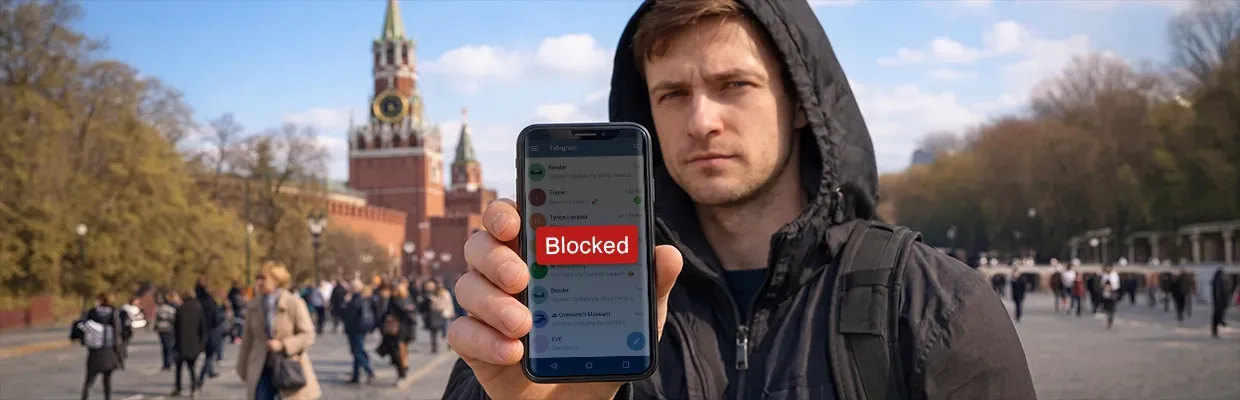
April 1 was the expected date for Russia's Telegram block. Russia moved it up by two weeks, quietly, over a weekend, with no announcement. Sure, let's call it a coincidence that the timing lines up with Moscow's blackouts so perfectly.
Telegram has been largely inaccessible across Russia since the weekend of March 14–15, with both mobile and desktop versions failing to open or load media. A full nationwide block had been expected in early April, following months of throttling and escalating pressure from Roskomnadzor.
But Russia didn't wait. Nearly 6,000 complaints were logged on Saturday alone. By Sunday, that number had doubled to 12,000, and now, the puzzle pieces are falling in.
Moscow Went Dark First, and Now We Know Why
Last week, before the Telegram block materialized, residents across multiple Moscow districts reported complete internet outages. Mobile service dropped out entirely in some areas. Where connections were held, they were limited to whitelisted sites only, and public Wi-Fi in the metro followed the same pattern, with Telegram absent and inaccessible.
Authorities called it drone defense. A source cited by RBC linked the disruptions to testing of Russia's whitelist system, and the Moscow internet blackouts that had many speculating about a broader agenda now look exactly like what they were – a dress rehearsal for what rolled out days later.
A Criminal Case, a Compliant Bureaucracy, and a Family Business
The official grounds for blocking Telegram have been building for months. Calls in Telegram and WhatsApp were restricted since the summer of 2025, and on February 10, Roskomnadzor announced "gradual restrictions" to force the platform to comply with Russian law, covering local servers, data localization, and anti-extremism tools. Reports of a full April 1 block followed two weeks later.
The pressure has also turned personal. State-aligned newspapers published claims in late February that Telegram founder Pavel Durov was under criminal investigation for "aiding terrorist activity," linking his platform to the assassinations of Darya Dugina and war blogger Vladlen Tatarsky. Durov denied it, replying that Russian authorities invent new pretexts daily to suppress privacy and free speech, which is honestly a whole lot more believable.
But what makes the whole operation even harder to dismiss as routine enforcement is the investigation published by journalist Andrey Zakharov on March 16. It found that Boris Korolev, 29-year-old son of FSB first deputy director Sergey Korolev, holds a position and likely a financial stake in X Holding, the company whose subsidiary Yadro manufactures the TSPU hardware installed across every Russian telecom operator's network. These are the systems Roskomnadzor uses to control traffic flows directly, with the telecoms themselves having no visibility into what happens inside them.
At least 80 billion rubles, roughly $980 million, have been allocated to deploy the systems nationwide, and the Korolev family holds real estate in central St. Petersburg, a Moscow apartment, and a fleet of Porsches and Mercedes, all acquired when the family had no documented income to account for them.
Every new platform that gets added to the block list means more traffic for the TSPU systems to process, more contracts to justify, and more revenue flowing to the people who built the infrastructure. For the Korolevs, blocking Telegram is as much a business decision as it is a political one.
When the Propaganda Arm Admits the Obvious
The Kremlin's own statements have made the real calculus difficult to obscure. Spokesperson Dmitry Peskov told an HSE conference on March 11 that Russia is "rapidly losing tools for propaganda work abroad" and can't reach audiences without the platforms it's blocking for its own citizens, which is a regime admitting out loud that this is about controlling information, not protecting it.
Meanwhile, Russian troops at the front continue using Telegram to coordinate operations, because Russia's own state-built replacement app is reportedly too insecure for combat use, so the block falls entirely on civilians. State Duma deputy Andrey Svintsov has already warned that VPNs won't help this time, saying the restrictions will make Telegram lag even over VPN, and I'd take that as confirmation that the infrastructure tested in Moscow last week is now fully operational.
The pattern isn't subtle, and governments that build censorship infrastructure of this scale, with security service families embedded in the supply chain, are never going to stop at one app. The 80 billion rubles already spent guarantee pressure to justify the investment, and every piece of hardware quietly installed on a telecom's network is one more tool available the next time a protest breaks out, an election approaches, or a journalist publishes something inconvenient.


Be part of the resistance, quietly.
Get Mysterium VPN
Dominykas is a technical writer with a mission to bring you information that will help you keep your digital privacy and security protected at all times. If there's knowledge that can help keep you safe online, Dominykas will be there to cover it.
Related Articles
.png)