Türkiye Jails a Journalist Mid-Holiday for Covering Institutional Corruption


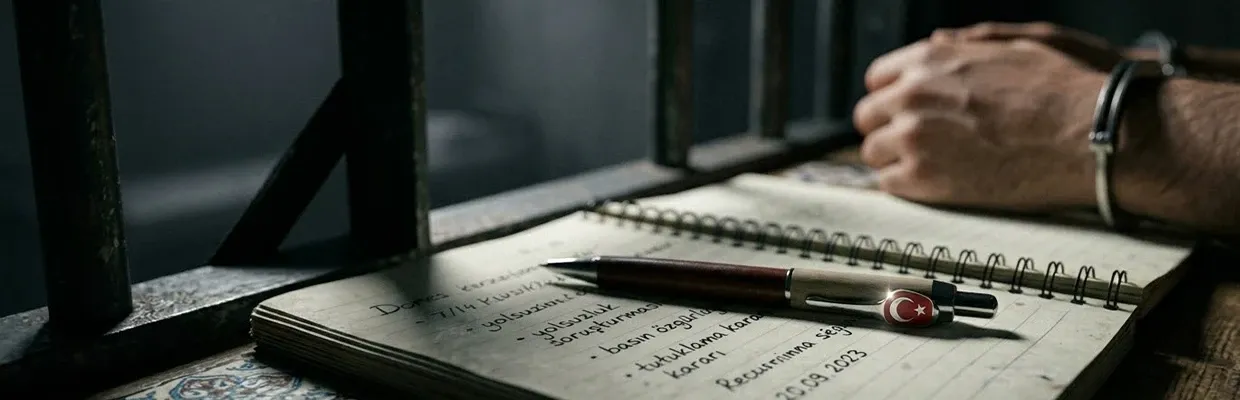
Not a Tuesday afternoon at the newsroom, not a formal summons, but 10 pm on Eid holiday, at your wife's family home, in a district 450 km from Ankara. That is when the Ankara Chief Public Prosecutor's Office decided to act on its case against İsmail Arı, and the timing tells you everything you need to know about what kind of "law enforcement" this actually is.
Arı is a reporter for BirGün, known for covering corruption and irregularities in public institutions. On March 21, he was detained in Turhal, Tokat, and transported to Ankara overnight to face charges of "publicly disseminating misleading information." The investigation had apparently been building for at least a year. According to Arı, they'd been looking for an excuse to arrest him for at least that long.
The Arrest That Skipped the Paperwork
After hours of questioning at the police station, Arı's procedures concluded at around 18:50. He was transferred to Ankara Courthouse at 20:00. Six lawyers arrived to represent him, including Kerem Altıparmak and former MP İlhan Cihaner.
But the prosecution didn't wait to take his statement before seeking detention. They referred Arı directly to the magistrates' court with a request for his arrest without that step. The magistrate remanded him in custody.
Skipping the statement like so is much more than a procedural oversight. It's what happens when the goal is custody rather than truth, and due process is an inconvenience to work around rather than a requirement to honor.
But regardless, Arı still passed a message to the public through his lawyers. He said he was detained because of a video from three months ago, that new tweets and old videos were being added to his case file to inflate it, and that "they've been looking for an excuse to arrest me for the past year anyway." He closed with four words: journalism is not a crime.
A Country That Has Been Running This Playbook for Years
Türkiye ranked 159th out of 180 countries in RSF's 2025 World Press Freedom Index, placing it among the lowest-performing countries worldwide for the second consecutive year. Approximately 90% of national media operate under direct or indirect government control, according to RSF. Independent journalism faces not only political pressure but also a structural environment designed to eliminate it.
The numbers from 2025 alone are staggering. A total of 105 journalists were detained, 40 were arrested, and 57 were sentenced in cases concluded that year, with courts handing down prison sentences totaling around 63 years.
The charge used against Arı, "publicly disseminating misleading information," is Article 217/A of the Turkish Penal Code, introduced in October 2022. Since then, at least 70 journalists have been investigated under it, with 15 detained, 4 arrested, and 27 indicted. The law carries one to three years in prison, and its wording is deliberately vague enough to give prosecutors wide discretion over what qualifies as "false."
I'd call the charge cynical, but that gives it too much credit. Calling documented corruption reporting "misleading information" is a signal to every journalist in the country about what subject areas carry personal risk.
The Real Offense Was the Beat He Chose
Türkiye's legal infrastructure for silencing journalists has grown substantially in recent years. A cybersecurity law that entered into force in 2025 expanded the powers of the Cybersecurity Directorate to search and seize digital materials without judicial approval, adding another layer to an already dense apparatus of legal pressure. The "misleading information" statute sits within that same apparatus, a charge with no hard definition, applied at prosecutorial discretion.
Arı covered public corruption. His reports exposed irregularities in public institutions. That's the beat. And in Türkiye in 2026, that beat comes with the risk of being picked up at your in-laws' house on a religious holiday over a video you posted three months ago.
The international community has watched Türkiye's press freedom record deteriorate for years, issuing statements, rankings, and reports, none of which have meaningfully changed the situation. If watching a country imprison journalists at a rate of 40 a year while ranking 159th out of 180 on press freedom isn't enough to prompt something more than a strongly worded index entry, then the rankings are only useful as a record of failure and not as a tool for stopping it.


Be part of the resistance, quietly.
Get Mysterium VPN
Dominykas is a technical writer with a mission to bring you information that will help you keep your digital privacy and security protected at all times. If there's knowledge that can help keep you safe online, Dominykas will be there to cover it.
Related Articles
.png)