The UK Wants to Turn Every Child's Phone Into a Surveillance Node by Default



Key Takeaways
- On June 8, 2026, PM Keir Starmer announced the UK will require Apple and Google to activate device-wide nudity scanning on children's smartphones and tablets within 90 days or face legislation.
- The mandate covers all apps, services, and the camera itself on existing and newly sold devices, with criminal liability threatened for tech executives who fail to comply.
- Signal published a statement the same day arguing the plan installs mass surveillance infrastructure that will not remain narrowly scoped once in place.
- Signal argues genuine child safety requires funded education and robust social services, not on-device scanning that consolidates Apple, Google, and Microsoft's control over personal data.
The Scan That Covers Every App, the Camera, and Whatever Comes Next
On June 8, Prime Minister Keir Starmer announced that tech companies, naming Apple and Google specifically, must activate device-wide nudity scanning on children's smartphones and tablets, covering all apps and services, including the camera itself. Per the UK government's announcement, tech companies have 90 days to comply or face legislation, with nothing off the table, including criminal liability for tech executives who refuse. Adults will retain access to nude content through an age verification process.
Apple had already taken some steps in this direction, introducing age checks for UK iPhone users and becoming the first company to activate safety features by default for those not verified as over 18. But the nudity detection does not extend to the camera, third-party messaging services, or search functions. The government's demand is to block nudity across the whole device by default, covering precisely the areas where UK age verification results have already shown the existing approach failing in practice.
Signal Explains Why the Infrastructure Is the Problem
Signal published its response the same day the announcement landed. The core argument is that mass surveillance capabilities, however sincerely framed at launch, never remain narrowly scoped. Once built into UK devices, the scanning layer's reach will be defined by government proscription, and what detects nudity today will be technically capable of scanning for political speech tomorrow.
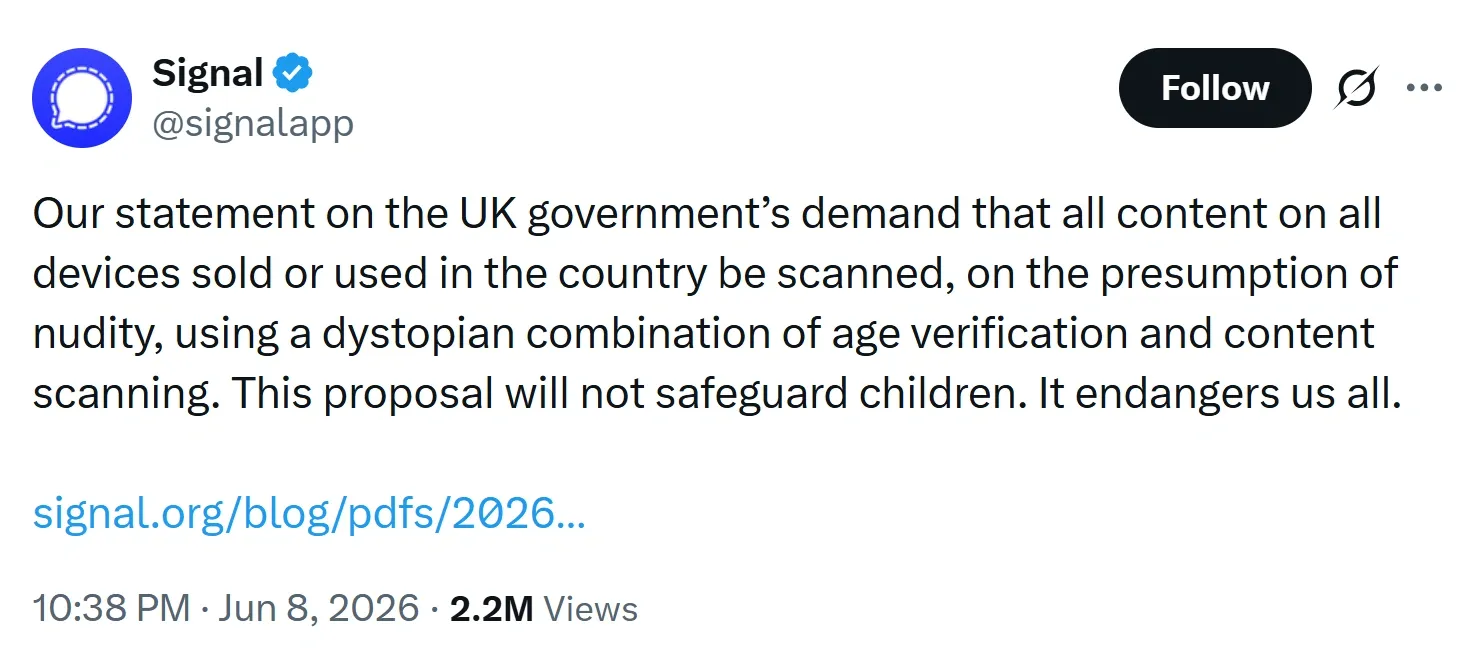
Beyond scope creep, Signal's full statement challenges the premise directly. Child safety, Signal argues, looks like well-funded education, robust social services, and meaningful guardrails on the AI technologies and platforms the UK government is simultaneously courting for economic growth. The government is demanding invisible surveillance infrastructure switched on by default instead.
Meanwhile, the UK safety consultation closed only two weeks earlier with over 100,000 responses received and a formal government response still pending, which makes announcing a device-level scanning mandate before publishing any of that evidence a revealing choice of sequencing.
The Moral Duty Framing and What It Actually Authorizes
There is a reason the announcement leaned so heavily on the moral duty argument. When protecting children is the framing, every question about scope, enforcement, and future expansion reads as an objection to child safety rather than a legitimate technical or civil liberties concern, and the governments enacting these laws are counting on that dynamic.
Signal is right that the infrastructure is the problem, and history backs that up with consistent evidence. Surveillance systems built under protective justifications have an unbroken track record of expanding their scope, strengthening the position of whichever large platforms control the scanning layer, and being adopted by governments less restrained than the one that commissioned them. The UK government announced this at London Tech Week while simultaneously pursuing closer relationships with the very companies it is threatening with criminal liability. That is not a tension it appears to feel.
The reality is that the child safety problem the government claims to be solving with this is real, even if nudity is a very many times less concerning issue than, say, insanely addictive social media algorithms that most of these lawmakers keep ignoring. If only the solution it has chosen didn’t create something far more permanent and far more general than the problem it was sold to address.


Be part of the resistance, quietly.
Get Mysterium VPN
Dominykas is a technical writer with a mission to bring you information that will help you keep your digital privacy and security protected at all times. If there's knowledge that can help keep you safe online, Dominykas will be there to cover it.
Related Articles
.png)