The Silent Backbone of the Internet, And Why Governments Are Eyeing It


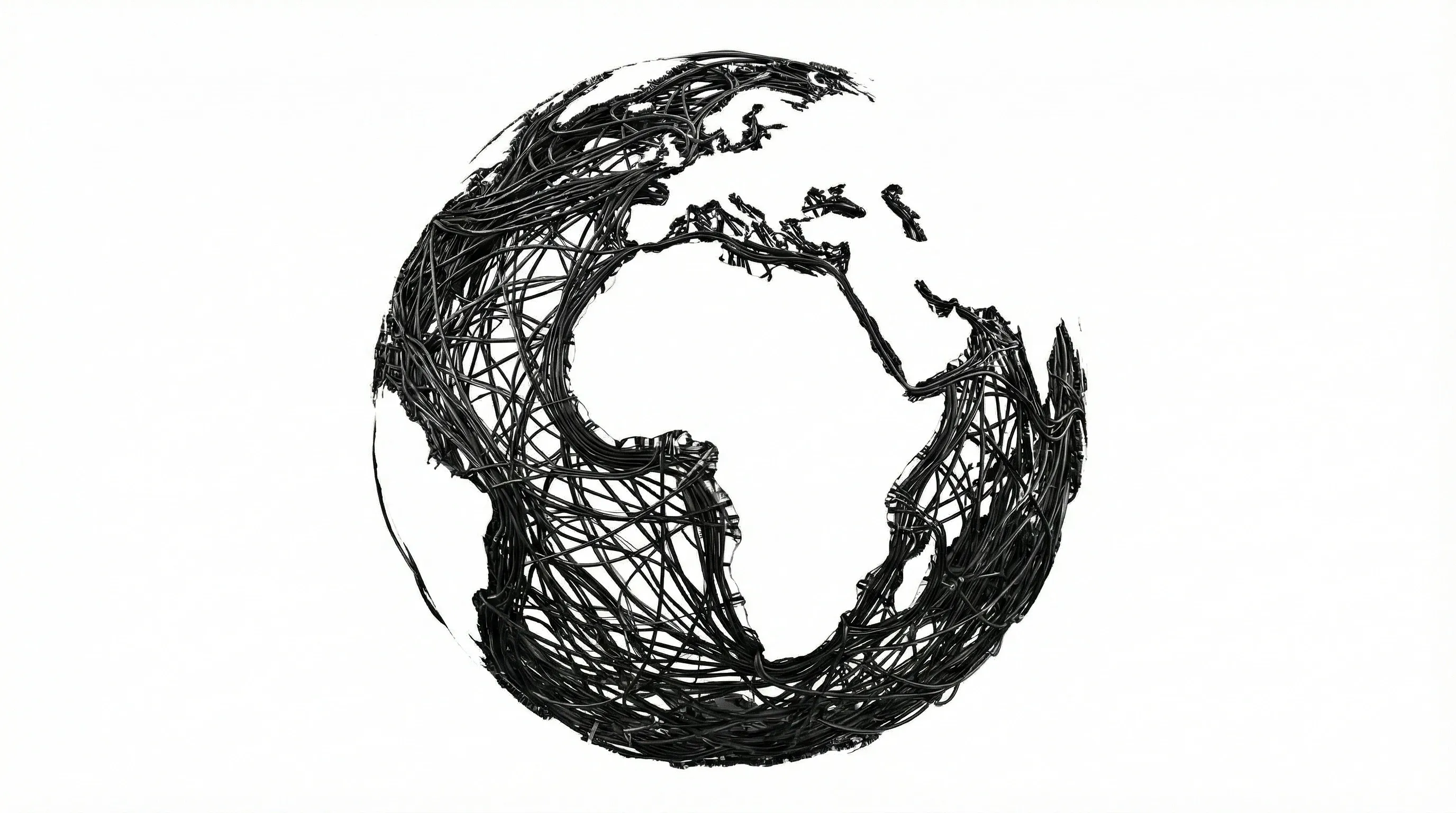
When people talk about the internet, they use words like “cloud,” “wireless,” or “virtual.” It sounds intangible, something abstract, like our information simply floats through the air. But that’s not how the internet works.
In reality, almost everything we do online (including your emails, video calls, streaming, banking, etc.) travels through physical cables lying on the ocean floor. According to the United Nations’ International Telecommunication Union (ITU) Deputy Secretary-General Tomas Lamanauskas, roughly 99% of global internet traffic moves through submarine cables stretching across the Earth’s seabed, alongside fish, mermaids, and everything else living down there.
The internet, in other words, isn’t somewhere in the clouds. It’s in the ocean. And as global geopolitical tensions rise, those cables are increasingly becoming targets.
The Infrastructure That Powers the Web
Undersea internet cables are among the most important (and least visible) pieces of infrastructure in the world. Today, according to the UN, there are more than 500 submarine cable systems spanning roughly 1.7 million kilometers across the ocean floor, connecting continents and carrying massive volumes of data every second.
Despite their importance, these cables are surprisingly thin. Most are roughly the width of your average garden hose, containing fiber-optic strands that transmit information at nearly the speed of light.
When you send a message overseas or watch a video hosted on a server across the world, your data likely travels through several of these cables before reaching its destination. This infrastructure quietly powers modern life. Without it, the global internet would simply stop functioning. And that is exactly why governments care about it.
The Ocean Floor Is Also a Surveillance Network
Submarine cables are valuable not only because they carry the world’s data, but because they make that data observable. Intelligence agencies have long understood this.
Documents revealed by Edward Snowden and reported by The Guardian showed that the UK’s intelligence agency GCHQ placed intercept probes on fiber-optic cables carrying internet traffic into and out of the country, allowing analysts to collect vast amounts of digital communications.
These systems temporarily stored enormous quantities of information, creating a searchable archive of internet traffic. The scale is enormous. At one point, intelligence analysts reportedly had access to tens of petabytes of data per day, including details about who people communicated with, what search terms they used, and where those communications originated.
This works because the architecture of the internet funnels massive amounts of global data through relatively small numbers of physical cables and landing stations. Tap the cable, and you can observe a huge portion of global internet activity passing through it.
Often, this kind of surveillance relies on cooperation from telecommunications companies that operate the cables or the facilities where they land on shore. For governments, that makes submarine cables incredibly valuable. They’re not just infrastructure. They’re strategic intelligence assets.
A Fragile System Beneath the Waves
Despite their importance, submarine cables are also surprisingly vulnerable. They’re designed to last about 25 years, but they face constant risks from fishing equipment, ship anchors, underwater landslides, and earthquakes.
The ITU estimates there are 150 to 200 cable disruptions every year. Most are accidental. But in recent years, security experts have begun warning that undersea cables are becoming something else: a potential target in geopolitical conflicts.
In the Baltic Sea, several submarine cables have been damaged in suspicious incidents since Russia’s invasion of Ukraine. European officials have raised concerns that sabotage could become part of so-called “gray zone warfare”, which is actions designed to destabilize rivals without triggering open military conflict.
Elsewhere, geopolitical tensions around strategic maritime routes create similar risks. Regions like the Strait of Hormuz, often discussed as oil chokepoints, also host dense clusters of internet cables connecting Asia, Europe, and the Middle East.
If those cables were disrupted during a conflict, the impact would extend far beyond the region itself. Countries like India, whose international connectivity depends on cables passing through nearby waters, could see large portions of their internet traffic affected.
The global internet may feel decentralized, but physically it runs through a relatively small number of corridors. That makes it efficient. But it also makes it fragile.
Why This Matters for Internet Freedom
For decades, the internet was often described as a borderless space, something too decentralized for governments to control.
That idea was always a little optimistic. Our beloved internet runs on infrastructure: cables, servers, routers, data centers, and power systems. Whoever controls or influences those systems has real power over how the information flows.
Submarine cables are one of the clearest examples of that power. Governments monitor them, regulate who builds them, and increasingly view them as strategic assets. Countries already compete over cable ownership and infrastructure projects, while security concerns shape which companies are allowed to participate.
What this means is that the physical layer of the internet, including the cables themselves, is becoming part of global geopolitics.
And when geopolitics enters the picture, openness often becomes a secondary concern.
You Should Pay Attention
Most internet users never think about submarine cables.
They only notice the infrastructure when something goes wrong, like when a service slows down, a region loses connectivity, or a major outage makes the news.
But the systems powering the internet shape far more of our lives than we usually realize.
Financial markets rely on them. Governments communicate through them. Businesses operate through them. Social platforms, cloud services, and streaming platforms all depend on the same underlying infrastructure.
When that infrastructure becomes vulnerable to surveillance, political control, or even physical disruption, the consequences ripple outward.
The internet may feel limitless, but it depends on a surprisingly small number of fragile physical systems. And those systems are increasingly caught in the middle of geopolitical tensions.
What Can You Actually Do?
None of us can personally protect an undersea cable thousands of meters below the ocean. But understanding the reality of how our internet works matters.
It reminds us that the internet isn’t some naturally free environment that exists on its own. It’s a human-built system, shaped by our governments, corporations, and the infrastructure they control.
When policymakers debate internet regulation, surveillance powers, or digital sovereignty, those decisions eventually translate into control over the systems that carry information itself.
The cables at the bottom of the ocean may be out of sight. But they’re very much part of the struggle over who controls the internet, and how free it remains.


Be part of the resistance, quietly.
Get Mysterium VPN
Gintarė is a cybersecurity writer at Mysterium VPN, where she explores online privacy, VPN technology, and the latest digital threats in editorial pieces. With hands-on experience researching and writing about data protection and digital freedom, Gintarė makes complex security topics accessible and actionable.
Related Articles
.png)