- Blog >
- Free Residential VPN: What’s Real, What’s a Trade-Off, and What to Avoid
Free Residential VPN: What’s Real, What’s a Trade-Off, and What to Avoid



Key Takeaways
- Truly free residential VPNs exist, but every one of them trades something away – your own IP, your bandwidth, or full-device coverage.
- The most common trade-offs are traffic sharing on peer-to-peer models (like tuxlerVPN), data caps on free tiers, and browser-only protection on extensions (like Anomi VPN).
- Mysterium VPN doesn't offer a free tier, but its Pro plan is currently $2.99/mo (78% off a 2-year plan), with 7,500+ residential IPs across 100 countries, coverage for up to 15devices, and malware protection included.
- A low-cost dedicated plan usually beats a free one once reliability, full-device coverage, or streaming use matters more than saving a few dollars a month.
Truly free residential VPNs exist, but none of them are free in the way you're hoping. Real ISP-assigned residential IPs cost money to maintain, so a provider offering them at no charge is recovering that cost somewhere else, usually by sharing your own connection with other users, capping how much you can use, or limiting protection to your browser instead of your whole device.
None of that makes these tools useless; it just means "free" is doing more work than the word usually implies. Here's what the actual options offer, what they cost you in other ways, and why a low-cost paid plan often closes the gap better than a permanently free one.
Why Free Residential VPNs Are Rare
ISP-assigned residential IPs are more expensive to source than datacenter IPs because they depend on real household connections rather than bulk-provisioned server infrastructure that a provider can spin up in a data center at scale. A datacenter VPN can add capacity by leasing more server space; a residential VPN can only grow by recruiting more real households or node operators, and that costs more per IP than renting a rack ever will.
Providers that offer residential IPs for free almost always offset that cost somewhere, through traffic sharing, data caps, browser-only access, or, in less transparent cases, by monetizing user data. Truly free, fully featured residential VPNs are genuinely rare for this reason: not because free providers are inherently untrustworthy, but because the economics simply don't support giving away something this expensive to run for nothing in return. For more on what makes an IP residential in the first place, learn what a residential IP address actually is.
The Free Residential VPN Options That Actually Exist
- tuxlerVPN: Runs on a community-powered, P2P model that lets you switch between residential and datacenter IPs. The main trade-off is that using it for free means sharing your own residential IP with the network, so other users can also connect to your IP, an arrangement worth understanding fully before opting in.
- Star VPN: Offers a free plan that rotates IPs sourced from home ISPs, alongside static residential IP options on paid tiers. Speeds can vary depending on network conditions and which IP you're routed through at a given moment, which is a reasonable trade for not paying anything, but it's worth setting expectations around.
- Anomi VPN: A free Chrome extension that routes browser traffic through residential IPs. It only covers what you do inside the browser, not apps, games, or other system-level connections, so it's a narrower tool than a full VPN client by design, useful specifically for browser-based tasks rather than as a general-purpose privacy layer.
Each of these suits a different need. tuxlerVPN suits someone comfortable trading their own bandwidth for free access. Star VPN suits someone who wants IP rotation without a subscription and can tolerate variable speed. Anomi VPN suits someone who only needs browser-level coverage. None of them is a drop-in replacement for a paid residential IP if what you need is consistent, full-device coverage.
The Trade-Offs Every Free Residential VPN Makes
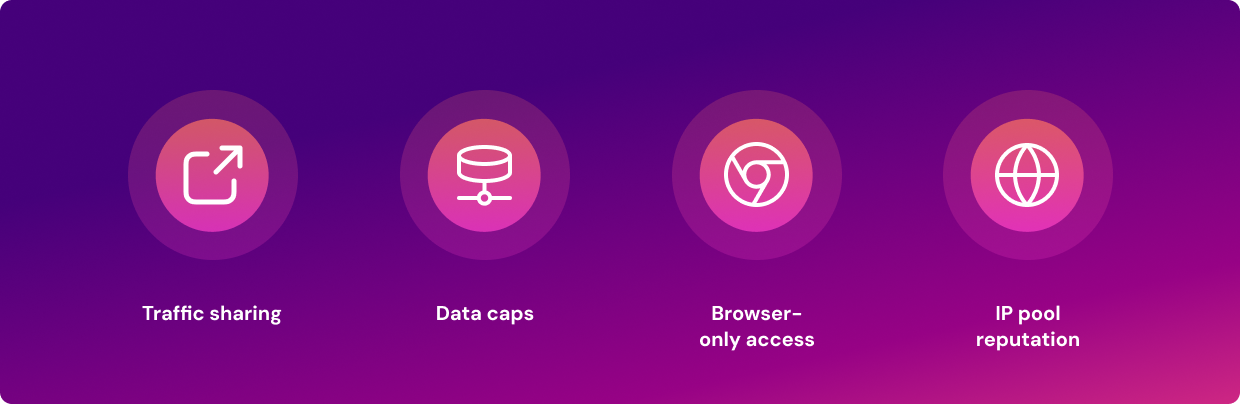
- Traffic sharing: Free peer-to-peer network ( tuxlerVPN model is the clearest example), works by sharing your residential IP with other users in exchange for using theirs. Your IP may be used for activity you can't see or control, which is a meaningful trade-off worth understanding before signing up, not something buried in the terms of service. It's the kind of arrangement that makes sense for some people and not others, depending on how comfortable you are with that exchange.
- Data caps: Most free tiers limit how much you can use monthly or daily, which restricts streaming, torrenting, or any bandwidth-heavy activity. A free residential IP that runs out after a few gigabytes isn't much use for anything beyond occasional, light browsing, and it's worth checking the actual cap before assuming a free plan will cover your typical usage.
- Browser-only access: Extensions like Anomi VPN protect only your browser traffic, not the rest of your device. Apps, games, and background system connections stay on your regular connection, so the privacy or IP benefit doesn't extend past whatever tab is open.
- IP pool reputation: Shared free IP pools can end up with worse reputation scores than dedicated paid IPs, since the pool's reputation depends on everyone using it, not just you. If another user on the same shared IP triggers abuse detection, your traffic through that IP can be affected too, through no fault of your own.
This is the gap a low-cost, dedicated residential VPN plan is designed to close, offering access to a residential network without asking you to share your own connection or accept browser-only limits. For a deeper look at how residential and datacenter IPs compare in detection and cost, see residential VPN vs datacenter VPN.
When a Freemium Residential VPN Makes More Sense
A dedicated, paid residential IP network avoids the trade-offs of a free option. No sharing your own connection with strangers, no data cap that runs out mid-stream, no browser-only limit that leaves the rest of your device uncovered.
For someone who needs reliable residential IP access, testing a geo-restricted service, checking how an ad campaign renders in a different region, or smooth streaming, the best residential VPN may be one that costs a few bucks but saves them a headache. Reliability is usually worth more than the price difference.
Mysterium VPN’s most popular plan, Pro, is currently 78% off a 2-year plan, at only $2.99/mo! At that price, the gap between "free with a catch" and "paid without one" is narrow enough that it's worth weighing directly rather than defaulting to free out of habit.


Reclaim the internet that took you at your word!
Get Mysterium VPN
Gintarė is a cybersecurity writer at Mysterium VPN, where she explores online privacy, VPN technology, and the latest digital threats in editorial pieces. With hands-on experience researching and writing about data protection and digital freedom, Gintarė makes complex security topics accessible and actionable.