VPN for Banking: Secure Your Online Transactions


.webp)
Key Takeaways
- Online banking is secure when proper precautions are taken, but public Wi-Fi, phishing scams, and malware remain common threats.
- A VPN encrypts your internet connection, protecting sensitive financial data from interception on unsecured networks.
- Cybercriminals often target banking credentials through social engineering, fake apps, and credential-stuffing attacks.
- Strong passwords, multi-factor authentication, and updated devices are essential for protecting financial accounts.
- Using a trusted VPN like Mysterium VPN adds an extra layer of privacy and security when managing money online — especially while traveling or using public networks.
Someone meddling with your financial information and your hard-earned money is a nightmare scenario for many people. Thankfully, banks and other financial institutions bend backwards to do everything they can to protect you, your money, and your sensitive information.
However, you also bear some responsibility for keeping your stuff safe. You're putting yourself in danger if you’re banking online on public Wi-Fi, in cafes, airports, trains, malls, etc.. But fear not, because Mysterium VPN is here to save the day.
In this Mysterium VPN article, we’ll talk about the dangers of online banking, what dangers may lurk behind the screen, and how you can protect yourself and your money the next time you’re engaging in some retail therapy or reviewing your accounts after a shopping spree!
Is VPN Safe for Online Banking?
Yes, generally speaking, using a VPN for online banking is totally safe, as long as you use a trustworthy and secure VPN provider.
Imagine if you had to get paid, but your boss would hand someone the money, and they’d have to bring it to you; who would you trust more? Your best friend, someone you’ve known for ages, or the faceless/nameless neighbor you run into by the front door? The answer’s pretty clear…
A trusted VPN provider will encrypt your internet traffic, making it unreadable (thus, unavailable) to hackers or anyone else snooping around on public Wi-Fi networks. However, not all VPNs are created equal.
You must do your research before picking a VPN, and avoid those providers that log your activity or leak your IP address. Instead, choose a VPN like our very own Mysterium VPN; that’s because we offer you strong encryption, a no-logs policy to maximize your security and privacy, all while offering flexible subscription prices that fit every budget!
Why Do You Need a VPN for Banking?

As our world becomes increasingly digital, the number of people who manage their money through online banks is growing. Sadly, this means that the number of people trying to scam you while banking online is also increasing proportionally.
Knowledge is power, so here’s an overview of the most essential online banking security risks.
Public Wi-Fi Attacks
Public Wi-Fi options, such as those available at coffee shops, airports, hotels, trains, malls, and other public places, are often unencrypted, unsecured, and, ultimately, unsafe.
When you access your online bank on these Wi-Fi networks, lurking hackers can perform man-in-the-middle (MITM) attacks, intercepting your data as it travels between your device and your bank’s servers.
This allows them to capture and exploit your sensitive information, such as your login credentials, bank account numbers, and transaction details. Unless you use encryption (such as a VPN), you’re basically broadcasting your financial data to anyone within your network.
Phishing and Social Engineering Scams
Phishing scams remain among the most effective ways cybercriminals steal your banking information. These scams typically come in emails, SMS (also known as smishing), or fake websites that mimic your real bank’s branding.
They trick you into entering your banking credentials, making you think that you’re logging into your real bank account. But you’re not; the bad guys now have access to your data.
Some phishing messages also urge recipients like you to immediately spring into action with fake, daunting warnings like “unauthorized login attempt detected”. Once you enter your information to explore this risk, attackers can take full control of your bank account.
Malware, Keyloggers & Trojans
If the device you use for online banking, like your smartphone or laptop, is infected with malicious software, such as keyloggers, banking trojans, or spyware, your login details and 2FA codes can be stolen silently.
Keyloggers record your every keystroke, while trojans can give hackers and other bad guys alike remote access to your device. These types of malicious malware often come bundled with suspicious downloads, pirated apps, or malicious links, emails, and text messages.
Fake or Cloned Banking Apps
Many people download mobile banking apps from third-party app stores or shady websites. Sadly, while these apps may look virtually identical to official bank apps, they’re actually designed specifically by hackers to harvest your banking credentials.
Once you enter your login information into the app, it gets sent directly to the attackers. Once you enter your login information, it gets sent directly to attackers. Even in official app stores, fake apps sometimes slip through, especially when using an outdated version of your OS.
SIM Swapping & 2FA Interception
A lot of banks nowadays use SMS-based two-factor authentication (2FA), which is better than no 2FA, but it’s still vulnerable to exploitation. With SIM card swapping, an attacker tricks your mobile carrier into transferring your phone number to their own device.
Once they have control, the attackers can receive your 2FA verification codes on their devices and thus reset your banking passwords. This tactic is growing in popularity and can bypass even strong login credentials.
Credential Stuffing from Data Breaches
If you, like many of us, like to reuse the same username and password across different websites and accounts, a data breach can put each of your accounts at risk, including your bank account.
Credential stuffing is a scam in which attackers use stolen login information from a leaked data breach and try it across multiple accounts, including various banks.
This scam technique is often automated and highly effective against users who don’t use a password manager or take the time to use and remember unique logins for each site.
Weak or Reused Passwords
If your passwords are weak and predictable (like "password123", your name, hometown, or birthdate), a hacker won’t even have to bother with credential stuffing.
All they have to do is look you up online to gather some background information about you, or Google a list of the most common passwords. Then, all they have to do is plug in passwords until they hit the jackpot, both metaphorically and literally.
Each account you own should have a different and complicated password, which should never be shared with anyone or stored insecurely, like a Post-it note in your bag. If you’re afraid of forgetting these passwords, invest in a password management tool.
Outdated Devices and Operating Systems
If you’re using an older device that no longer receives regular security updates, you’re putting yourself at risk. Outdated operating systems often contain unpatched vulnerabilities that a motivated hacker can easily exploit.
This same logic applies to outdated banking apps or browsers. You must always update your devices, operating systems, and apps to the latest version to stay protected from these threats.
Lack of Encryption and Secure Connections
Not all websites and apps are created equally. If your bank’s app doesn’t use end-to-end encryption, or if you accidentally connect to a fake phishing version of their official website, your sensitive data could be transmitted in plain text.
It’s vital to ensure that the website address begins with “https://", and consider using a VPN to add an extra layer of encryption. More on that later!
What Are the Benefits of Using a VPN for Online Banking
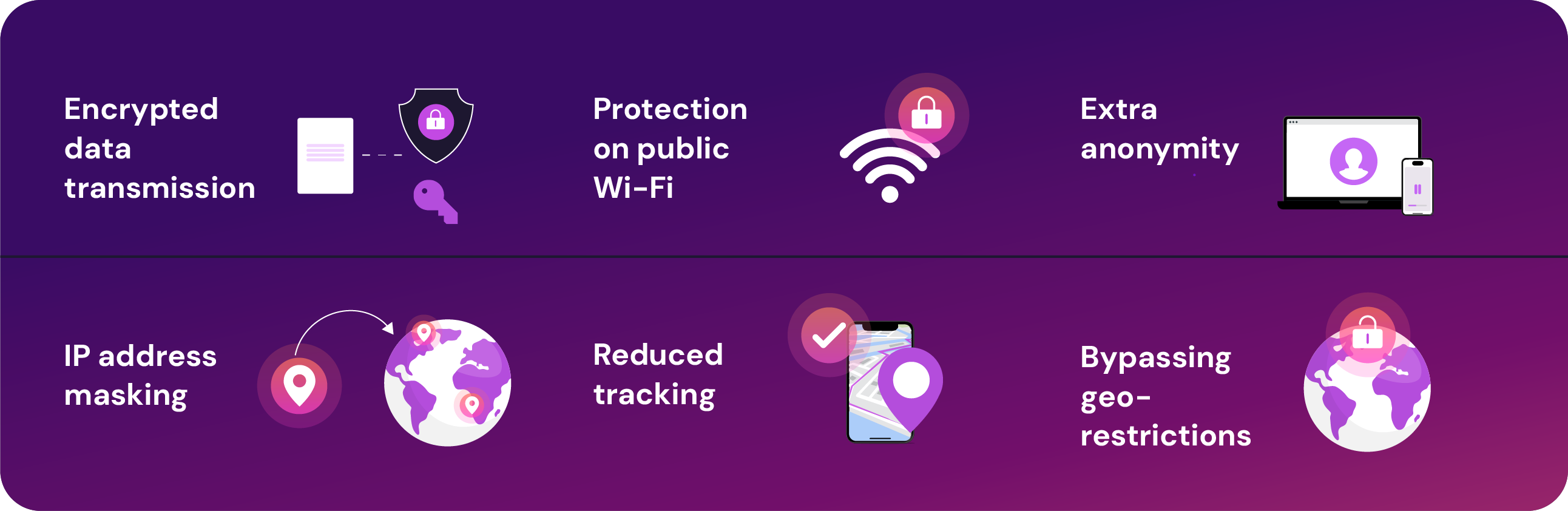
Using a VPN to conduct your financial transactions adds many layers of security:
- Encrypted data transmission: Your login information and transaction details are always protected in transit and safe from pesky snoopers.
- IP address masking: Hiding your IP address makes you and your devices anonymous, and thus, much safer in the online world.
- Protection on public Wi-Fi: When you use a VPN, your online activity gets an invisibility cloak of sorts, making your actions untraceable.
- Reduced tracking: When your activity is hidden, websites and trackers lose the ability to profile you and your behavior.
- Extra anonymity: A VPN keeps your online activities private from ISPs and network admins.
- Bypassing geo-restrictions: Changing your virtual location allows you to access your bank from abroad without triggering the bank’s false fraud alerts.
When To Use a VPN for Online Banking
Whether you’re on vacation or just grabbing a latte at a coffee shop, here’s when using a VPN becomes essential for your financial security.
When Using Public Wi-Fi
Like we’ve said before, publicly available and, often, password-free Wi-Fi options are a breeding ground for bad guys looking to get a hand on your sensitive data, including your banking information. Whenever you’re connected to a Wi-Fi that you don’t trust, it’s better to stay on the side of caution and use a VPN.
When You’re Traveling
Using a VPN for travel is essential because your IP address changes when you go abroad, often triggering your bank’s security systems. To avoid login issues, connect to a server in your home country—this makes your IP address appear as if you’re still back home.
While Using a Mobile Banking App
Even some mobile apps can be vulnerable to hacking, especially if you’re on public Wi-Fi. Using a VPN when you’re banking on your phone is a great way to keep you, your device, and your bank accounts safe and sound.
When a VPN Doesn't Protect You
Although a VPN is a powerful tool, it isn’t an all-powerful magic shield. It protects your internet connection, but won’t protect you if you’re not practising basic online security fundamentals. Here are a few scenarios where a VPN won’t help you:
- Weak or reused passwords: You should always use strong and unique passwords that aren’t easy to guess, or that could be found in data leaks. A strong password and a password manager are two great tools for keeping up with password safety norms.
- Phishing scams: VPNs can’t detect fake websites or emails for you. If you click on a fraudulent link and willingly enter your login information, even a VPN won’t help you.
- Infected devices (malware, spyware): A VPN doesn’t clean your system, as it’s not a separate antivirus tool. If your device is compromised, attackers can see everything you’re doing, even if you’re using a VPN.
- Fake banking websites: VPNs encrypt data, but they don’t verify the legitimacy of the site you’re on. Always check the URL and look for the “https://” in the website address.
- Untrustworthy VPNs: Free, low-quality VPNs may track your activity, sell your data, or expose you to leaks, which totally defeats the purpose of using a VPN to enhance your online security.
Will a VPN Work With My Bank?
Most major banks work totally fine with VPNs. However, some banks may temporarily block access to well-known VPN servers as a preventative measure against fraud.
If this happens, you should try the following steps:
- Try connecting through a different VPN server in your country.
- Clear cookies and website cache from your browser.
- Avoid switching servers during your banking session.
- Use a VPN provider with residential IPs or rotating servers, like Mysterium VPN.
Additional Online Banking Security Tips
We’ve already discussed how a VPN is a great tool to make your online banking experience much safer. However, it’s only a part of your digital security toolkit. You should follow these safety tips for online banking:
- Use multi-factor authentication (MFA).
- Regularly update your apps and devices.
- Avoid saving your passwords in browsers, like your Google Account.
- Use strong, unique passwords with a password manager.
- Keep your devices malware-free with dedicated antivirus software.
- Log out of banking sessions when done, especially on shared or public devices.
- Ensure you’re on your bank’s official website before entering sensitive information.
- Enable transaction alerts to monitor account activity in real time.
- Avoid clicking links in emails or texts, and log in directly to your bank’s app or website, especially if the message seems urgent or unusual.
By combining these safety habits with the security of Mysterium VPN, you significantly reduce your exposure to threats and keep your money safe in your bank account, where it belongs.
What Should You Look for in the Best VPN for Banking
When choosing a VPN provider to protect your online banking, make sure it includes the following essential features for security and ease of use:
- End-to-end encryption (AES-256 or higher): Protects your data from interception during transmission.
- No-logs policy: Ensures your online activity and personal information are never stored or shared.
- Leak protection: Prevents DNS, IP, and WebRTC leaks that could expose your identity.
- Stable servers: Reliable, high-speed servers—especially within your country—ensure seamless banking.
- Mobile compatibility: Works smoothly on Android and iOS banking apps.
- Kill switch: Instantly disconnects your internet if the VPN connection drops, avoiding exposure.
- Helpful and responsive support team: If problems pop up, you’ll need a helpful and quick support team, preferably one available 24/7 to account for travel time zones.
- User-friendly interface: Easy setup with minimal configuration—no technical expertise required.
These features collectively ensure that your banking sessions are private, encrypted, and uninterrupted, no matter where you are.
If you’re looking for a simple way to secure your financial activity online, Mysterium VPN combines strong encryption, a strict no-logs policy, and a global network of secure servers to help protect your connection wherever you bank — now up to 78% off.
Final Thoughts
Online banking is convenient, but it’s not without risks. From public Wi-Fi attacks and phishing scams to malware and SIM swapping, plenty of threats are waiting to exploit careless habits or unsecured connections.
While banks have strong security measures, your personal cybersecurity practices matter just as much. Using a reliable VPN like Mysterium VPN adds a vital layer of protection, especially when banking on public networks or while traveling.


Reclaim the internet that took you at your word!
Get Mysterium VPN
Frequently Asked Questions
Gintarė is a cybersecurity writer at Mysterium VPN, where she explores online privacy, VPN technology, and the latest digital threats in editorial pieces. With hands-on experience researching and writing about data protection and digital freedom, Gintarė makes complex security topics accessible and actionable.
Related Articles
.png)