How to Pay for a VPN Anonymously? Shop Without Leaving a Trace



Buying an app subscription online is normally as easy as typing in your card details and your full name into a checkout form. But what if you want to stay hidden while you do it? What if you don’t want your bank account or credit card tied to your VPN subscription?
Here at Mysterium VPN, we talk a lot about privacy online. We live and breathe it. So today, we’ll be taking a practical look at how to pay for your VPN (or anything else, for that matter) anonymously, why you may want to do it, and which tools can help you to stay off the radar.
Think of this blog post as your roadmap to maximum anonymity. Grab your metaphorical trench coat and your sunglasses, and let’s get to it!
Why Should You Pay Anonymously?
If you want the most anonymous VPN setup, start with how you pay. Anonymous payments let you subscribe to a VPN service without exposing personal details like your full name, your billing address, and your payment information. So, paying like this makes a pretty big difference, especially if your goal is to remain anonymous while browsing or avoid leaving behind a digital trail.
It’s important to point out that not everyone who pays anonymously is trying to hide something nefarious. Many people simply prefer not to overshare their personal data across the internet. In a world full of data breaches and growing surveillance, anonymity is a giant advantage to have.
Benefits of Paying Anonymously
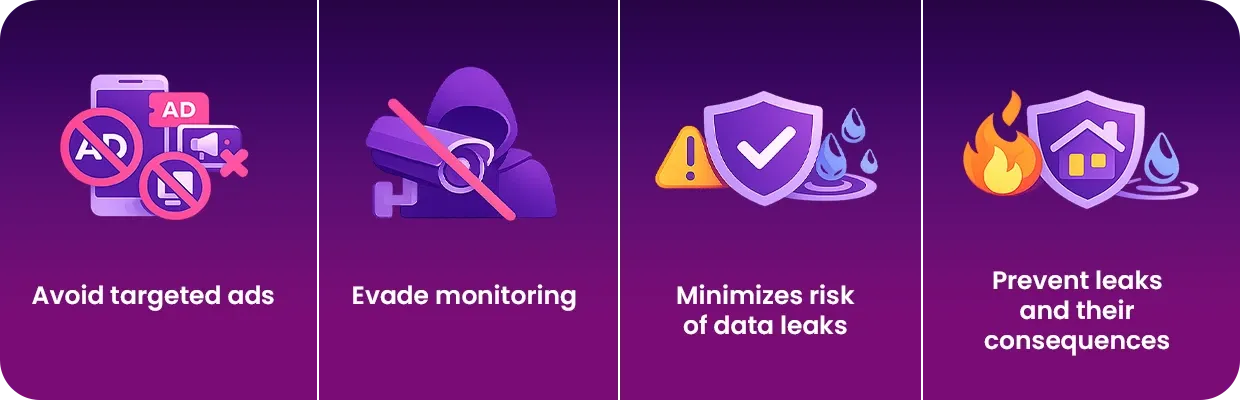
Paying for your VPN subscription anonymously has real advantages; let’s take a look at them.
- Avoid targeted ads: The more information you give third parties, the more creepily targeted you get. No oversharing = no targeted advertising.
- Evade monitoring: Traditional payments pass through banks, credit card companies, and payment processors. Anonymous payments help you to skip their monitoring.
- Minimizes risk of data leaks: When you pay anonymously, you reduce the amount of personal data any company holds on you, minimizing the damage a breach could do.
- Prevent leaks and their consequences: If you don’t have data to leak, you’ll be safe from the aftermath, including identity theft and being targeted by scammers.
Not everything in life is perfect, including the alternative payment option of your choice. Let’s take a look at the potential drawbacks of shopping anonymously.
Drawbacks of Paying Anonymously
Anonymous payments are great for privacy, but trade-offs exist. It’s only fair to mention them:
- Limited product options: Not all VPN providers accept anonymous payments. Although VPNs care about privacy, most of them don’t support alternative payment methods.
- Additional setup time: If you want complete anonymity, payments will require extra effort. It may not always be complicated, but it takes time and patience.
- Complicated refund process: Refunds are tricky for anonymous payments. That’s because companies return money to the original payment methods, and it gets tricky.
- Not user-friendly: Some methods, especially crypto, involve you learning a few technical steps, which may not be accessible for every shopper.
- Potential restrictions: Depending on your location, anonymous payment methods may not be available. International payments may also become too complicated.
If these anonymous payment method drawbacks didn’t drive you away, you’re on the right track – let’s move on and take a deeper look at anonymous payment methods.
Data Leaks From Online Stores
It may seem slightly overly paranoid to look for ways to shop online without giving away your personal information, regardless of whether you’re buying shoes or a 2-year Mysterium VPN subscription (our best deal yet!).
But the risks of data leaks loom over us and happen more often than companies’d like to admit. Let’s take a look at some of the infamous data leaks that hurt innocent customers.
In December of 2017, when most people are buying Christmas presents and decorating their homes, nearly 500 thousand people in Brazil got some bad news: the Brazilian retailer Netshoes had almost half a million records hacked and posted publicly. Customers of the retailer had their dates of birth, email addresses, full names, and their purchase history leaked.
For a more recent example, let’s look back on October 2025, when Mango, the global fashion retailer, informed its customers via email that a third-party marketing breach occurred. Mango told its unfortunate customers that their first name, country of origin, postal code, email address, and phone number (all information used for marketing purposes) were in the hands of hackers.
And last but not least, let’s remember the November 2024 Hot Topic data breach, which exposed the dates of birth, genders, partial credit card data, physical addresses, email addresses, names, phone numbers, and purchase history of over 59 million customers!
If you don’t want to suffer the same fate, we recommend using Mysterium VPN to protect your data while you shop, and consider using anonymous payment methods to pay for the goods. If you’re unsure where to start, keep reading!
Anonymous Payment Methods to Consider
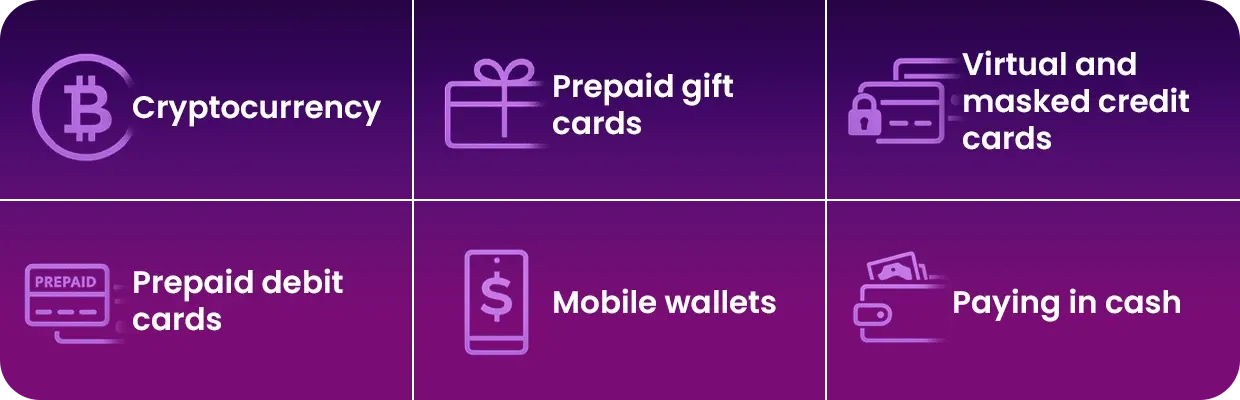
If you want to pay for something without handing over your personal information to third parties and various merchants, there are many payment options available that provide you with multiple levels of anonymity. Here’s an overview:
Cryptocurrency
Cryptocurrency transactions are one of the most popular ways to pay for something without giving away your real identity. Bitcoin, Ethereum, Monero, and other digital coins allow you to make payments without using your real identity. But how anonymous is it, really?
Bitcoin transactions are recorded on a public ledger known as the blockchain. And anyone who has your transaction ID can see when crypto was sent, how much of it, and the address of the sender and the recipient, but this information won’t identify you by your full name. Your crypto wallet also isn’t personally identifiable.
Not all cryptocurrencies work in the same way, though. Privacy-focused coins like Monero hide your transaction details much better, so if you want maximum anonymity, these types of coins are a strong choice for a payment option.
If you really want to stay anonymous when buying something online, consider using the Tor browser to create a new wallet and buy cryptocurrency in small amounts to improve your user privacy as much as possible.
Prepaid Debit Cards
Prepaid debit cards are one of the oldest tricks in the book for anonymous online purchases. You can buy a debit card at a local shop with cash payments, load it with as much or as little money as you want onto it, and then use it like you would a regular card.
This is an excellent option for paying for a VPN subscription plan when you want to avoid linking your real identity or payment data. When choosing a prepaid debit card, pick one that allows international payments if your VPN provider or online shop of choice is based in another country.
Prepaid Gift Cards
Prepaid gift cards are similar to prepaid debit cards (try saying that fast!), except they’re often easier to buy. You can find them hanging out on racks in supermarkets, pharmacies, and even gas stations.
Some gift cards are specific to certain stores (like a fast food restaurant, a coffee shop, or a book shop), but others, like Visa or Mastercard gift cards, work almost everywhere.
If your goal is buying a VPN anonymously without any fuss, these cards are a lifesaver – buy one with cash, bypassing your bank account, load it up with money, and spend it however you like without giving companies too many of your personal details.
Mobile Wallets
Apple Pay, Google Pay, and similar mobile wallets can protect parts of your payment information by creating virtual card numbers instead of sharing your actual card information. This means that your VPN provider never sees your banking information.
While some mobile wallets also allow you to hide your email address, these payment methods don’t completely hide your purchase details or your sensitive data from the bank; they can still see your transactions, as they’re the ones who hand over your money.
This method isn’t entirely anonymous, but it can definitely add an extra layer of privacy to your online purchases compared to traditional payment methods.
Virtual and Masked Credit Cards
Some services, like the Privacy Card or IrenVest, can generate temporary card numbers for your online payments. You’d be using your regular credit card, but the service would add a level of security by giving you a temporary number that the merchant would see, similar to changing your IP address with a VPN.
You should keep in mind that these temporary numbers still leave your card linked to your real bank account somewhere in the background. So, while they protect your card data, they don’t necessarily protect your identity.
Use this method if your main goal is improved security rather than anonymity.
Paying in Cash
Yes, going old school and paying in cash is still a valid option. Some VPN providers out there allow you to pay in cash by mailing money in a literal envelope. This may feel retro, but if it works, don’t fix it, right?
Cash payments are anonymous because there’s no digital trail of payment, only a record of you taking money out of your account, but not what you do with it. However, you need to keep in mind that snail mail isn’t perfect, and sending valuables, like money, has its own risks.
If your privacy needs are significant to you, it’s possible to find a provider that accepts cash payments, and you can still pay for a VPN account this way.
How to Pay for Mysterium VPN?
When you’re buying a Mysterium VPN subscription, our primary goal is to protect your privacy from the moment you land on our site to the moment you connect to a VPN server. You can pay for a subscription using one of three options: a mobile wallet (Google Play or Apple Pay), a debit or credit card, or cryptocurrency.
Below is a breakdown of how these buying processes work and what personal information may be visible to us, or our trusted payment partners. We follow strict privacy rules, and we only ever collect the minimum amount of your information needed to keep your account in order.
If you want a deeper look at how we handle your personal information, feel free to read our full Privacy Policy, or contact customer support for explanations not in legalese. All payments are encrypted and secure, regardless of the method you choose.
Google Pay or Apple Pay
Using your mobile wallet is one of the easiest ways to buy a Mysterium VPN subscription. You enter your email for the new account, tap the button for the mobile wallet of your choice, confirm the payment on your phone, and that’s that!
Since these mobile wallets create virtual card numbers, we never see your real card details. We only receive the payment confirmation and basic payment information that’s required for processing your subscription, including:
- Your masked card information;
- Your email address (possible to hide with some mobile wallets, including Apple Pay);
- Your billing address;
- Your transaction information, like the last digits of your card and the issuing bank;
- Your name as it appears in your payment data.
Our payment processing partners include Stripe, Apple Pay, Google Play, and Adyen. These companies may see the same financial information they typically collect during any online purchase. We don’t see your VPN use, your browsing history, your IP address, or anything else connecting you to the VPN.
Debit or Credit Card
This is the classic and most commonly used way to pay for anything, ever. It’s fast and straightforward: you type in your card details, enter your billing address, and complete the payment the way you usually would. Here’s the information we see:
- Your partial card details;
- Your billing address;
- Any payment status details, like failed or cancelled transactions.
None of this payment information is connected to your VPN usage. As stated in our privacy policy, we don’t keep any logs of browsing history, websites visited, IP addresses, or the nature of your online traffic.
Our payment processing partners include Stripe, Apple Pay, Google Play, and Adyen. These companies may see the same financial information they typically collect during any online purchase. We don’t see your VPN use, your browsing history, your IP address, or anything else connecting you to the VPN.
Cryptocurrency
Cryptocurrency payments are the most private way to pay for a Mysterium VPN subscription. We support crypto payments through our partner, CoinGate. If you already have a crypto wallet, the entire process takes just a few minutes.
During checkout, you enter your email address, choose crypto as your preferred payment method, pick a specific coin, and send the exact amount of money to the address generated for your transaction. Once the payment is received, your Mysterium VPN subscription activates. The information revealed in this process is minimal:
- Your email address;
- A timestamp of when the transaction happened;
- A transaction confirmation from CoinGate;
- The amount of crypto you paid;
- The type of cryptocurrency used.
Neither Mysterium VPN nor CoinGate sees your full wallet history, your private keys, or your full name. The safest way to purchase a Mysterium VPN subscription with cryptocurrency is to use our partner, CoinGate, without creating an account with them.
This way, both CoinGate and we don’t receive any personally identifiable information about you. All we see is the email address you use to create your VPN account (you can create a separate one), and the transaction ID, which, as we covered before, only identifies when the transaction happened, how much of which crypto type was paid, and the wallets (not identifiable) that sent and received the funds.
No matter how you choose to pay for our services, your privacy stays at the center of everything we do. We only collect the information that’s strictly necessary to activate your account and keep it running. Nothing more. We never log your browsing activity, we don’t track your IP address, and we don’t store details that reveal your identity online.
Your payment method is your choice, and your identity remains yours.
Key Takeaways
At the end of the day, you’re responsible for your own safety online. It’s up to you to determine whether websites are safe, and to figure out ways to minimize the amount of personal data you’re sharing with the internet. Take your time to learn how to shop online safely and how to shop anonymously.
We’ve covered many useful things in this blog post. Let’s take a look at the main things we discussed about online shopping anonymously:
- Anonymous payments help protect your identity, payment details, and online privacy.
- Crypto is super private, but prepaid debit or gift cards are easier for beginners.
- Mobile wallets and virtual credit cards offer increased security, but not anonymity.
- Cash provides complete anonymity, but is slow and inconvenient.
All in all, you should always choose a payment method that fits both your comfort level and your technical skill level. For instance, if crypto is still rocket science to you, stick with a mobile wallet that hides your bank details and your email address while making a purchase. But if you’re knowledgeable in crypto, that’ll be your best bet.
Test out how crypto payments work with Mysterium VPN! Use your preferred crypto coin to get yourself a Mysterium VPN subscription & stay safe!


Be part of the resistance, quietly.
Get Mysterium VPN
Frequently Asked Questions
Gintarė is a cybersecurity writer at Mysterium VPN, where she explores online privacy, VPN technology, and the latest digital threats in editorial pieces. With hands-on experience researching and writing about data protection and digital freedom, Gintarė makes complex security topics accessible and actionable.