The EU is Still Funding Serbia While Its Government Vilifies the Press


Key Takeaways
- Ten press freedom groups, including ARTICLE 19 Europe, sent letters to European Affairs ministers at their May 9–10 Brussels gathering demanding they back the suspension of EU funds to Serbia.
- Physical attacks on journalists in Serbia surged 367% in 2025, yet Serbian authorities secured only three convictions during the entire period.
- A March 2026 smear campaign on national TV named over 45 journalists as "enemies of the state," explicitly referencing past murders of Serbian journalists.
- EU Enlargement Commissioner Marta Kos has separately proposed withholding Serbia's €1.5 billion in EU funding over sustained democratic backsliding, giving the coalition a concrete policy hook to push on.
A 367% Surge, Three Convictions, and a Government That Helped Cause Both
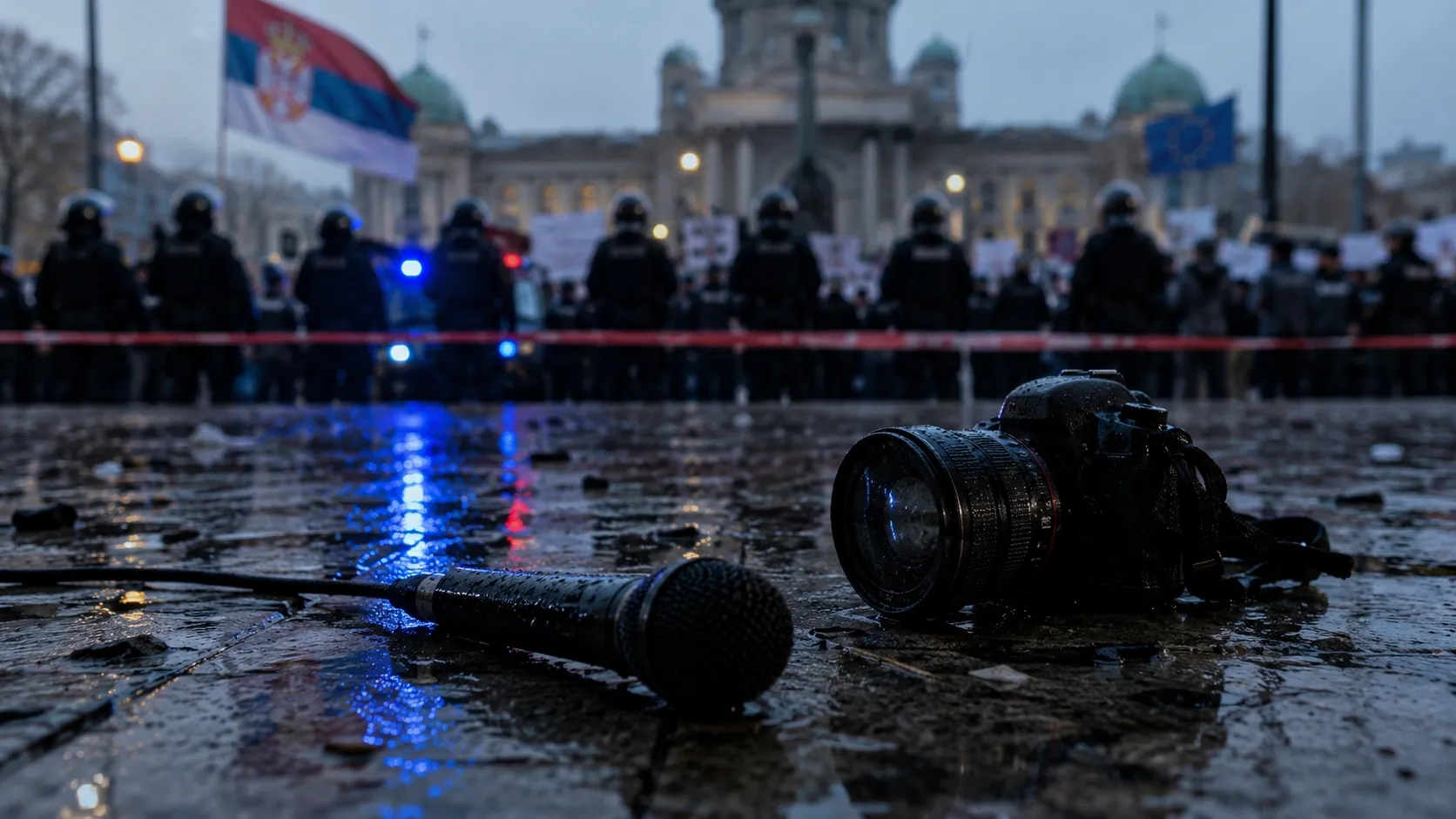
Ten press freedom organizations, led by ARTICLE 19 Europe, sent letters last weekend to European Affairs ministers gathered informally in Brussels, calling on them to back EU Enlargement Commissioner Marta Kos's proposal to withhold Serbia's EU funds. The ask is not complicated. Use the financial leverage the EU already has before someone gets killed.
The numbers say it all – physical attacks on journalists in Serbia increased by 367% in 2025. During that same period, Serbian authorities secured exactly three convictions. The organizations describe the gap between the scale of violence and the absence of accountability as a near-complete failure of state protection, and I think that description is generous.
The March 2026 smear campaign made the government's posture even clearer. Serbian national television broadcast a segment naming over 45 journalists as "enemies of the state," explicitly referencing previous murders of journalists in the country. Combined with the ongoing physical attacks and near-total impunity for perpetrators, the coalition states plainly that all the ingredients for a deadly attack on a journalist are now in place.
How Belgrade Turned Its Press into a Target
The current crisis traces back to November 2024, when a concrete canopy collapsed at the Novi Sad railway station, killing 16 people. Nationwide protests followed, and the Serbian government's response was to treat the journalists covering those protests as part of the problem rather than the public record.
President Aleksandar Vučić labeled independent broadcasters N1 and Nova S as "doing pure terrorism." Ruling party officials and pro-government media took up the framing, calling journalists "insects," "non-humans," "terrorists," and "traitors." The organizations note that this language, coming from the highest levels of government, has directly translated into violence against individual reporters on the ground, with police among the perpetrators and almost no intervention or prosecution following attacks.
Strategic lawsuits against public participation have been deployed as an additional tool, a familiar tactic in governments that want to silence the press without always reaching for the baton. Serbia has refined the combination, discrediting, legally harassing, and physically intimidating journalists, with state actors driving each layer and facing essentially no consequences for any of it.
The EU's Very Long List of Reasons Not to Act
Commissioner Kos told EU lawmakers in April 2026 that the European Commission is evaluating whether to suspend Serbia's €1.5 billion in EU funding, citing judicial independence failures, crackdowns on protesters, and recurrent interference with independent media. She was, by Brussels standards, unusually direct.
And yet, the ten organizations are not writing to the Commissioner. They are writing to European Affairs ministers, because the Commission alone cannot force this. Member states have to want it, and so far their appetite for confronting Belgrade has been limited despite years of documented backsliding and a monitoring record that leaves no room for surprise.
Serbia has received only pre-financing under the EU's Growth Plan for the Western Balkans, sitting well behind neighbors like Montenegro, Albania, and North Macedonia that have already received reform tranche payments. The funds are conditioned on reform, but the reforms are not happening. Governments that suppress their press rarely reverse course without pressure that actually costs them something.
The coalition's demands to EU member states are specific, asking Serbian authorities to immediately halt smear campaigns, end impunity for crimes against journalists, reform law enforcement's behavior at protests, end arbitrary surveillance, and implement meaningful legal protections including anti-SLAPP measures. That is a clear, actionable list. The EU has the leverage to make it expensive to ignore. What it lacks, so far, is the will to use it.
I am not holding my breath for a rapid turnaround from Brussels. But at some point, continuing to fund a government that brands its journalists as enemies of the state and watches them get beaten on camera stops being "complicated geopolitics" and starts being a choice. The question is not whether Serbia qualifies for the money. Commissioner Kos has already signaled it probably does not. The question is whether European Affairs ministers will act on that signal now or spend another year writing reports while the attacks keep coming.


Be part of the resistance, quietly.
Get Mysterium VPN

Dominykas is a technical writer with a mission to bring you information that will help you keep your digital privacy and security protected at all times. If there's knowledge that can help keep you safe online, Dominykas will be there to cover it.
Related Articles
.png)