Massachusetts House Votes to Ban Kids From Social Media



Key Takeaways
- The Massachusetts House voted 129-25 on April 8 to ban children under 14 from social media, with parental consent required for 14- and 15-year-olds. The Senate must still agree before the bill goes to Governor Healey.
- The bill mirrors Florida's HB 3, which has been partially blocked, contested, and partially reinstated by a divided federal appeals court since it passed in 2024.
- Systematic reviews and a large-scale 2025 University of Manchester study found no consistent evidence that social media use causes mental health harm in adolescents.
- Age verification requirements expose all users to surveillance infrastructure, harm LGBTQ+ youth in particular, and have been routed around by minors within days everywhere they have been tried.
A Copy of a Law Still Fighting in Court
On April 8, the Massachusetts House passed a bill to ban children under 14 from social media platforms, with parental consent required for users aged 14 and 15. It also bans personal devices during the school day and targets October 1, 2026, for the social media provisions to take effect, though the Senate has not yet voted on the social media portion. Until both chambers align and the governor signs, nothing is law, but for the social media blanket ban advocates, this is a win nonetheless.
House leaders were open about their model. Rep. Aaron Michlewitz, chair of the House Ways and Means Committee, compared the bill directly to Florida's HB 3, sharing the same age threshold and parental consent structure. Florida's version, signed in March 2024, has been challenged in federal court by Google, Meta, and Snap on First Amendment grounds.
It was blocked, then partially reinstated by a divided appeals court in November 2025, and the lawsuit continues still. Michlewitz acknowledged Massachusetts could face the same legal exposure, saying they think they're "on solid ground,” which is the same claim Florida's legislators made.
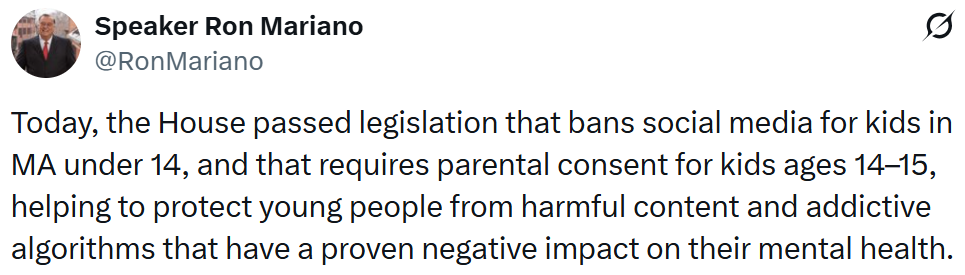
House Speaker Ronald Mariano celebrated the vote by saying the bill addresses algorithms with a "proven negative impact" on children's mental health. His official statement framed it as protecting children from harmful content and addictive algorithms. When asked about data privacy concerns, Mariano said it was "worth the investment" of getting the right ages in place, which is not an answer to the privacy question so much as a redirect away from it.
The Research Keeps Saying No
A University of Manchester study published in December 2025, which followed 25,000 young people aged 11 to 14 over three school years, found that social media time did not predict emotional or behavioral problems. Systematic reviews and meta-analyses back that up, consistently showing small and inconsistent associations between social media use and adolescent mental health, with causation not established.
Columbia University Mailman School of Public Health reached a similar conclusion in 2025, finding that evidence supporting social media restrictions carries "significant limitations" and that policymakers are regularly outpacing the research they claim justifies their decisions.
Legislators were not unaware of the opposition. Fight for the Future, which advocates for free expression online, said the bill kills anonymity online for all users regardless of age. Act on Mass went further, pointing out that the law would force every Massachusetts social media user, including adults, to submit biometric information to prove they are over 16.
The bill also added language barring platforms from sharing a minor's LGBTQ+ status with parents. But while that is a meaningful addition, the underlying mechanism that makes such sharing possible in the first place, mandatory identity collection, remains intact.
The same First Amendment concerns that put Florida's law in front of a federal appeals court apply here in full. Massachusetts legislators know this, acknowledged it, and passed the bill anyway.
Age Verification Builds Infrastructure, Not Safety
Every social media ban requires age verification, and age verification requires identity. The data does not stay local and instead flows to platforms and their third-party verification vendors, creating a permanent pipeline that outlasts the child safety rationale used to build it.
The pattern is consistent. When Brazil's Digital ECA took effect in March 2026, VPN downloads spiked 250% overnight, with minors routing around the ban using parent credentials or borrowed logins within days. Australia's under-16 ban, which took effect in December 2025, produced the same result.
The surveillance infrastructure those laws built did not disappear when the bans proved ineffective either. In March 2026, 419 security and privacy researchers from 30 countries signed an open letter calling for a moratorium on age verification deployment precisely because of this: the infrastructure it builds can be adapted to enforce any access control policy once it exists, long after the child safety rationale is forgotten.
Massachusetts Has Legitimate Grievances and the Wrong Answer
The concerns driving this bill are real. Platforms have spent years optimizing for engagement at the expense of user wellbeing, and the documented harms, particularly from algorithmic amplification of harmful content toward vulnerable teens, are serious. That much, I mean sincerely.
And yet Massachusetts chose a blanket ban modeled on a law still in court, built on a research base that does not support it, and enforced through identity verification that harms the users it claims to protect.
If the actual goal was protecting children, the bill would have targeted platform accountability for predatory algorithm design, funded digital literacy programs, or required independent safety audits before products reach minors. Estonia made exactly this argument when it rejected the EU's own social media ban push, pointing out that the rules already exist and platforms simply aren't following them.
But instead, Massachusetts handed the identity verification industry a legal mandate and called it child protection. The Senate still has a vote to cast. They should use it to ask what evidence this bill is actually built on, because the answer is not what the House floor said it was.


Be part of the resistance, quietly.
Get Mysterium VPN
Dominykas is a technical writer with a mission to bring you information that will help you keep your digital privacy and security protected at all times. If there's knowledge that can help keep you safe online, Dominykas will be there to cover it.
Related Articles
.png)