Minecraft’s Latest Update Just “Muted” the UK Unless You Show Your ID


Key Takeaways
- According to a Minecraft spokesperson statement (shared via email to YouTuber ibxtoycat), UK players will need to verify they're over 18, starting in February, to retain access to social features like chat, Xbox friend communication, Discord/Twitch integration, and Looking for Group (LFG) features.
- This is described as part of Microsoft and Mojang's compliance program for the UK Online Safety Act.
- Verification is handled through third-party service Yoti, which the spokesperson states uses industry-standard encryption and deletes data after the check is complete.
- Players who don't verify keep access to the game itself but lose social/multiplayer-adjacent features.
- Microsoft has reportedly indicated it may extend this age verification to other regions if the UK rollout "works."
Minecraft is arguably the best-known game in the world. Many of us grew up playing, and many still grow up playing it to this day. Yet, it seems that not even this gaming treasure is immune to the new age of global online restrictions.
Probably no one ever bought Minecraft thinking they’d one day have to flash their real‑world identity just to type in chat. Yet here we are. Under the banner of “online safety,” one of the most beloved games on the planet is about to test how much surveillance players are willing to tolerate to keep their social lives intact. It’s yet another brick in a much bigger wall of internet restrictions that are quietly reshaping what it means to go online.
Minecraft’s Age Check: What’s Actually Changing
Minecraft has quietly crossed a new line. Only this time, it’s not a cool, never-before-seen feature that makes the game better. It’s how you’re allowed to exist online.
According to a statement from a Minecraft spokesperson, shared in an email sent to YouTuber ibxtoycat, UK players with adult accounts will soon have to verify that they’re over 18 to keep access to social features such as chat. The move is part of Microsoft and Mojang’s compliance program for the UK Online Safety Act.
Players will be invited to confirm their age through third‑party service Yoti, which, the spokesperson assures, uses industry-standard encryption for protection and deletes all data after the check’s complete. The goal, on paper, is “safe and age‑appropriate experiences.”
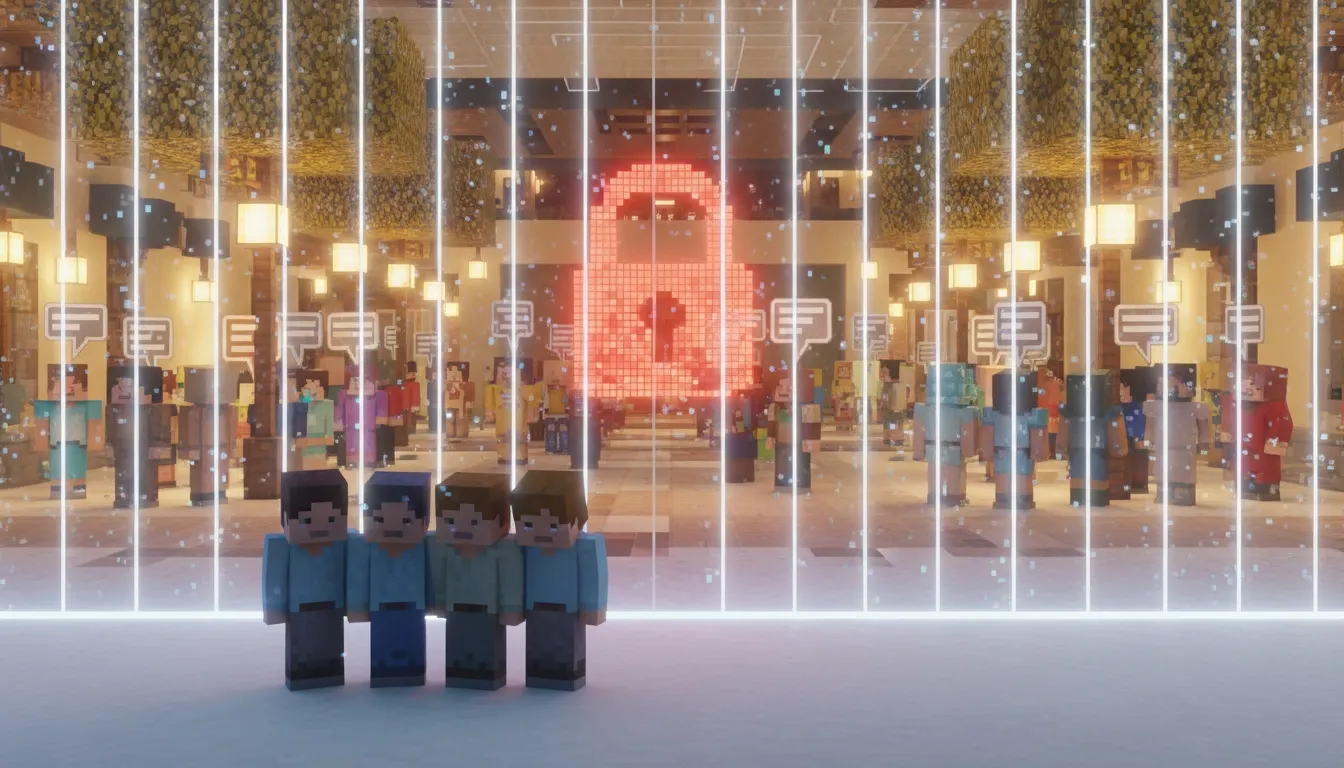
If you refuse to verify, the punishment’s simple: you keep the game and lose your social life. That means no in‑game chat with strangers, only limited communication with Xbox friends, no Discord integration or other third‑party services, no Looking for Group (LFG) features, and no direct streaming from console to Twitch or Discord.
At the same time, if you agree, this becomes yet another online place where you’ve got to upload your most sensitive data just to access the base features that you always had access to before. All that while putting faith in the same old "no data will be retained" promise that consistently turns out to be false.
Of course, the UK is just the pilot. Microsoft is very clear that if it “works,” they plan to extend age verification to more regions and experiences. And just like with other recent online restrictions, "works" isn’t at all based on whether it actually protects children, only that it’s enforceable.
The New Normal Of “Prove Your Age To Talk”
We’ve seen this movie before. Earlier this month, Roblox rolled out age verification checks for all players and restricted online chat functions after renewed “concerns” about child safety. Naturally, it didn’t take long to turn into the disaster we all expected. Adults were getting false negatives, kids – false positives, features disappearing, and workarounds already circulating within hours.
Now, one of the biggest open sandbox games on the planet is copying the script. Same logic. Same tools. Same vague promise that “player safety” is worth the trade.
On paper, it’s hard to argue with “protect children.” In practice, the way these laws and systems are being built has some ugly side effects. They transform long‑running communities into gated spaces where your right to speak depends on ID checks.
They quietly rewrite what you thought you bought when you paid for a game so that you may own access, but your age, documents, and biometrics now decide which parts you’re allowed to use, and they centralize power in governments and platforms that can change the rules at any time, then call it “compliance.”
This keeps happening over and over again. First, it was just the adult content and gambling, then social platforms and app stores, and now, it’s games. Soon enough, we might have to flash our IDs just to say "Hi" to a friend online.
Every step’s framed as “just this one category” and “for the kids.” But the technical machinery underneath is the same: large‑scale identity checks that are very tempting to repurpose for other kinds of control.
Why Age Verification In Games Hits Different
Social networks have always been account‑based. You sign up, you share your life, and you sort of expect some ID friction. But games are different. People paid for Minecraft in 2011 and have been playing on random servers ever since, often under the same pseudonym. For many, that account’s a decade of friendships, builds, server history, and creative work.
Some of my own fondest gaming memories happened purely because of some chance encounters on random Minecraft servers. That’s because the social aspect of these games is pretty much just as big as the creative.
Sure, it’s a sandbox that’s all about building cool stuff and surviving. But it’s also about doing all this together, and if we take such a massive aspect of the game away from kids, aren't we really hurting them more than actually protecting them?
Now, if you’re an adult account holder in the UK, you’ve got to confirm you’re over 18 starting in February or lose access to social features. You can still play. Your worlds don’t vanish. But the living part of the game, the multiplayer culture, gets sliced away.
That stings for a few reasons, because people bought a product that didn’t have this requirement. It’s not just a new feature but a new condition layered on top of something already sold and trusted. Not everyone’s comfortable uploading government ID or facial data to a third‑party scan just to chat in block game servers. And that should be a reasonable choice, not a punishment trigger.
That's exactly how community‑driven games lose the people who care about privacy the most. That’s often the same crowd that runs good servers, moderates responsibly, and builds tools the ecosystem depends on. So while there might not be any real danger for kids in Minecraft right now, there certainly will be one once this happens. And then, voilà, the restriction now has an actual "reason."
The Hidden Costs Of “Online Safety”
Behind Minecraft’s reassuring language about the age checks sits a bigger, unresolved problem that we keep bringing up over and over again. Once you centralize highly sensitive data like IDs, selfies, and facial scans, you create an irresistible target.
Breaches happen, data gets repurposed over time, and companies grow overly confident in automated verification instead of investing in real safety measures like good moderation, sane defaults, and actual user education.
Many critics point out that sweeping age‑verification systems not only don't keep children safe but also make it harder for people to anonymously access information, including content that adults are fully entitled to see and that young people might seek out for political, health, or personal reasons.
When games like Minecraft and Roblox turn into ID‑only zones, they stop being just entertainment and start functioning as tightly controlled social spaces, where speech and exploration are chilled for anyone who can’t or won’t hand over real‑world documents.
And yet, arguably the worst part, at least from the children's perspective, is how these restrictions not only do not protect them but effectively ruin their experiences that could otherwise easily become some of the most beautiful core memories of their childhood. But who even cares about that, right?


Be part of the resistance, quietly.
Get Mysterium VPN
Dominykas is a technical writer with a mission to bring you information that will help you keep your digital privacy and security protected at all times. If there's knowledge that can help keep you safe online, Dominykas will be there to cover it.
Related Articles
.png)