Inside Russia's Layered System of Internet Control


Key Takeaways
- Russia's internet censorship operates as a layered system that combines blacklists, sovereign infrastructure, wartime speech laws, and anti-VPN measures.
- Since the 2022 invasion of Ukraine, the pace of restrictions has accelerated sharply, with independent media, social platforms, and news sources now blocked or throttled.
- Russians can face criminal prosecution not just for publishing banned content, but for accessing or sharing it, even privately.
- VPN usage in Russia surged after major platforms were blocked, but the state is actively trying to shut that door too.
I spend a lot of time thinking about internet freedom. It's part of why I'm here, working on a product that helps people access the web without being watched or filtered. But Russia isn't just an interesting case study to me. It's a warning.
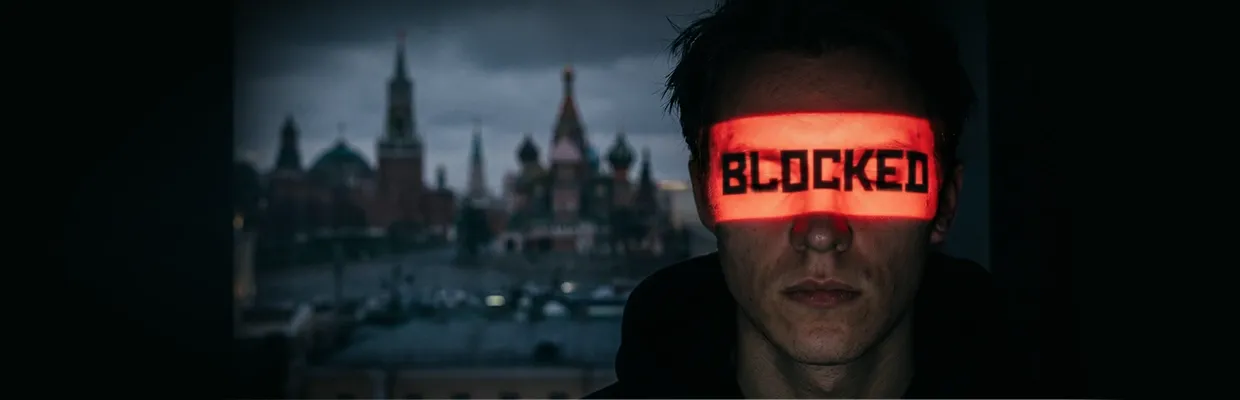
What's happening there isn't a government blocking a few inconvenient websites. It's something more systematic, and honestly, more terrifying. Russia has spent years building a layered control system designed to turn the internet from a public space into a tightly managed one. Understanding how it works matters, whether you live there or not.
It Started With a Blacklist
Russia's censorship infrastructure has a formal name and address. The Unified Register of Prohibited Websites, managed by Roskomnadzor (Russia's federal communications body), is a live blocklist that internet providers are legally required to follow. You can actually look it up; the website is publicly accessible, at least in theory. Neither my team nor I could get it to load, no matter how hard we tried. So much for transparency.
The list started with relatively uncontroversial targets: child sexual abuse material, online drug marketplaces, and suicide instructions. But it grew fast, and the criteria got looser. By the time Russia invaded Ukraine in February 2022, Roskomnadzor had the infrastructure and the legal authority to block almost anything, almost instantly.
And block they did. Facebook, Instagram, and later Twitter were restricted or banned outright. Independent Russian outlets were forced to shut down or go into hiding. Even simple Google searches for certain terms started returning filtered results. Meduza's reporting on Roskomnadzor's reach documents this expansion in uncomfortable detail.
The "Sovereign Internet" Wasn't Built for Freedom
In 2019, Russia passed a law that most people outside the country barely noticed. The so-called "sovereign internet law" (RuNet law) required Russian ISPs to install deep packet inspection (DPI) hardware, controlled by the state, directly on their networks.
The stated reason was protecting Russia from being "disconnected" by outsider adversaries. In reality, it gives the state the ability to throttle, redirect, or fully cut off internet traffic (domestically or from abroad) with a flip of a switch.
That's not a firewall. That's a kill switch. And unlike China's Great Firewall, which was built from the ground up, Russia retrofitted this system onto existing infrastructure. That's technically harder. The fact that they did it anyway tells you something about how passionate they are about this.
Saying the Wrong Thing Is Now a Crime
The blacklist and the DPI infrastructure handle what people can see. A parallel set of laws handles what people can say.
Since 2022, Russia has passed a wave of speech laws that are vague on purpose. A law criminalizing the "discrediting" of the Russian military passed within days of the invasion. Calling it a "war" instead of a "special military operation" became grounds for prosecution. The Kremlin's own documentation of these laws frames them as protecting truth from misinformation — which would be funny if the consequences weren't so serious.
The penalties are real. Journalists have tracked hundreds of prosecutions. Journalists, activists, and ordinary people have faced fines, detention, and prison sentences for social media posts, reposts, and even private messages that were reported to authorities.
What's chilling about this isn't just the prosecutions that happen. It's the fact that people won’t dare to speak out, self-censoring themselves in fear of consequences. That's the real goal of this whole thing.
Running Out of Patience With VPNs
When Instagram was blocked in March 2022, VPN downloads in Russia spiked by over 2,000%. People weren't going to just accept being cut off. They found the door and walked through it.
Russia noticed. The state began demanding that VPN providers comply with Roskomnadzor's blocklist, effectively asking privacy tools to become censorship tools. Most refused. Many were blocked as a result. Apple and Google were pressured into removing VPN apps from their Russian app stores, and complied with at least some of those requests.
This is where I think the story gets personal for us. At Mysterium VPN, we believe that access to the open internet isn't a privilege;and it's something people shouldn't have to fight for. Watching a government systematically dismantle the tools people use to protect their own privacy and access information makes the work feel urgent in a way that's hard to overstate.
It's Not Just Russia Watching
Freedom House's Freedom on the Net 2025 report rates Russia as "Not Free", scoring it near the bottom globally. Human Rights Watch's 2025 report on Russian internet control documents throttling, blocking, and the chilling effect on civil society in sharp detail. These aren't numbers produced by people with a political agenda. They're the result of careful measurement.
The European Court of Human Rights already ruled that Russia's website-blocking regime violated the right to freedom of expression under the European Convention on Human Rights. Russia's response was to withdraw from the Council of Europe in 2022. It's hard to interpret that as anything other than choosing censorship over accountability.
What This Means Beyond Russia's Borders
Here's what I keep coming back to: Russia didn't build this system overnight. The blacklist started in 2012. The sovereign internet law came in 2019. The speech laws accelerated after 2022. Each step was incremental. Each step was justified with language about safety, security, or protecting citizens from harm.
That pattern (gradual escalation, each step framed as reasonable) is worth paying attention to everywhere. Meduza's reporting on Russia's shrinking speech space captures this well: it isn't a sudden switch from free to unfree. It's a slow narrowing of what's allowed, what's sayable, what's searchable.
Russia is an extreme case. But the tools it built, like the centralized DPI infrastructure, platform pressure, anti-circumvention laws, and criminal liability for consuming certain information, aren't unique to Russia. Other governments are watching, and some are quietly borrowing.
That's why internet freedom isn't just a Russian problem. It's a global one. And it's why I think the work of building open, decentralized, privacy-first infrastructure matters more than ever. Not as a political statement. Just as a practical response to the world as it is.


Be part of the resistance, quietly.
Get Mysterium VPN
Gintarė is a cybersecurity writer at Mysterium VPN, where she explores online privacy, VPN technology, and the latest digital threats in editorial pieces. With hands-on experience researching and writing about data protection and digital freedom, Gintarė makes complex security topics accessible and actionable.
Related Articles
.png)