- Blog >
- News >
- Amazon Built a Detailed Profile on You Based on Your Shopping History. Here's How to See It
Amazon Built a Detailed Profile on You Based on Your Shopping History. Here's How to See It



Key Takeaways
Amazon's "About You" feature, officially launched in May 2026, uses purchase history to build a profile of a user's interests, hobbies, preferences, and physical characteristics.
The feature went viral after a Threads user discovered Amazon had determined she "has flat buttocks," likely inferred from a purchase of butt scrunch leggings.
Amazon users can view their About You profile through their account settings on desktop or mobile.
The profile is a visible, user-facing version of the inference engine Amazon has run for its customers for decades. Amazon has used most of what the profile contains internally for targeting long before it became visible to users.
A Threads post went viral this week after its author discovered that Amazon had concluded she "has flat buttocks," alongside more typical assumptions about her shopping preferences and hobbies. The post received more than a million views in under a day, with thousands of other users rushing to check what Amazon had listed about them. The author later suggested the physical characteristic was probably inferred from a purchase of butt scrunch leggings — which is correct, and is also exactly how inference engines work.
Amazon officially launched the "About You" feature in May 2026. It pulls from your purchase history to generate a profile of your interests, preferences, and physical characteristics, which you can view through your account settings. The feature isn't new in substance — it's a user-facing window onto something Amazon has been doing internally for as long as it has sold things to you. What's new is that it's visible, which is why it's generating the reaction it is.
The flat buttocks detail is funny. The reaction it produced — "I mean it ain't wrong but damn did you have to call me out like that?" — is the natural human response to being accurately profiled by a machine. But the humor is concealing something worth looking at directly: the surprise people feel when they see this profile is the surprise of meeting a system that has been running on them continuously, without their moment-to-moment awareness, for years.
Users on TikTok have also been sharing their own “About You” pages, with hilarious observations like “has a bad father”, “perceived their dog as evil”, and “gradually building bidet collection”. Or this one, about a TikTok user supposedly owning a rodent named Ethan who lives in their ceiling. In the name of data protection, we’re not featuring the person’s username or profile photo – the internet clearly has more than enough of their data.
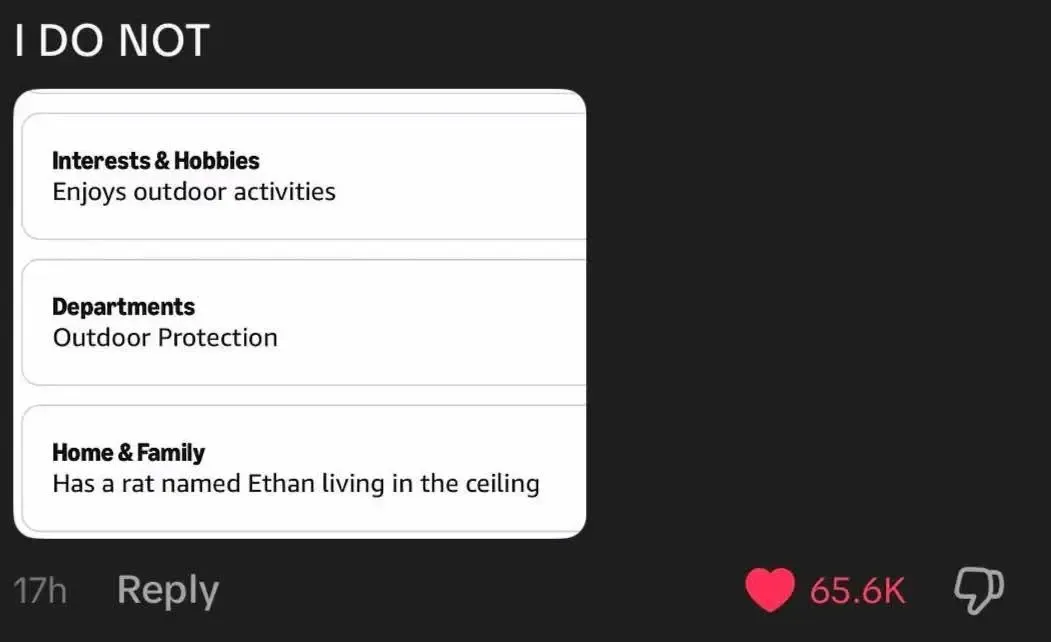
Screenshot of a comment from a TikTok video, captured October 8th, 2026.
And although it may seem funny that Amazon assumes you have daddy issues or have a preference for bidets, some people online are rightfully concerned about how this data collection happens in the first place.
How Amazon Knows What It Knows
Amazon's inference engine doesn't work from any single data point. It works from patterns across everything you've ever bought, searched for, browsed, returned, and reviewed on the platform — combined with what it knows about other customers with similar patterns.
When you buy butt scrunch leggings, Amazon doesn't record "this person has flat buttocks." It records the purchase, correlates it with what other purchasers of that product also bought, what characteristics that product is associated with in customer reviews, and what that cluster of purchases predicts about your other preferences and characteristics. The inference emerges from the pattern, not from a single item. That's what makes it both accurate and unsettling: it's more reliable than you'd expect precisely because it's drawing on far more information than any single purchase would reveal.
This is the same logic behind every product recommendation you've ever received from Amazon — the "customers also bought" list, the personalized homepage, the targeted emails. The About You page is just the part of that inference that's been made legible. The rest of it has always been there, shaping what you see and what prices you're offered, without ever being shown to you directly.
What Amazon Does With It
The profile exists to serve Amazon's advertising business. Amazon Ads is one of the fastest-growing advertising platforms in the world, and it sells advertisers access to targeting based on exactly this kind of inferred consumer profile — what you buy, what you're interested in, what physical characteristics the platform has associated with your account. The About You page gives you a glimpse of the profile. It doesn't give you a complete view of how that profile is used or who it's shared with.
Amazon isn't alone in this. Every major platform running on digital advertising is doing a version of the same thing. Google infers your interests from your search history, your YouTube watch patterns, your email content, and your location data. Meta infers from your likes, your scrolling behavior, your friends' demographics, and the data it buys from third-party brokers. The difference with Amazon is that your purchase history is a particularly high-signal source — you didn't just express interest, you spent money — which makes its inferences more precise and more commercially valuable than most.
What makes the About You page worth engaging with isn't the flat buttocks detail. It's the reminder that every purchase you make on a platform like Amazon is also a data point in a profile that's being used to target you, price products for you, and sold to advertisers who want access to people like you. That process doesn't require your awareness. It runs in the background regardless.
What You Can Do — and What You Can't
You can view your About You profile through your Amazon account settings: on desktop, go to Account > Ordering and shopping preferences > Your Shopping preferences, then scroll down to "Manage your information." On mobile, tap the menu icon, then Account > Shopping preferences > About you.
Amazon allows you to edit or remove interests from the profile, which changes what the visible page shows. It doesn't delete the underlying purchase and browsing data that generated those inferences, and it doesn't remove you from Amazon's advertising targeting infrastructure. Editing the About You page is closer to correcting a label on a filing cabinet than to clearing the files inside it.
If you want to actually reduce what Amazon knows and infers about you, the options are more limited: don't use an Amazon account, don't log in when browsing, and don't make purchases that you'd prefer not to associate with your name. For most people, that's not realistic — which is precisely why the data exists in the first place.


Be part of the resistance, quietly.
Get Mysterium VPN
Gintarė is a cybersecurity writer at Mysterium VPN, where she explores online privacy, VPN technology, and the latest digital threats in editorial pieces. With hands-on experience researching and writing about data protection and digital freedom, Gintarė makes complex security topics accessible and actionable.