China's Police Force Just Got Glasses With Real-Time Facial Recognition


Key Takeaways
- Chinese police in Tianjin are now wearing domestically developed smart glasses with live facial recognition connected to government databases, capable of identifying people in milliseconds.
- The glasses are officially framed around traffic management, finding missing elderly people, and urban governance, but the same infrastructure that finds a lost grandfather can identify any person on any street, any time.
- China's public security tech market has grown from 10.8 billion yuan in 2015 to 25.5 billion yuan in 2025, signaling a long-term infrastructure investment, not a pilot.
- The rollout is not unique to China, with India and the Netherlands having run similar pilots and ICE in the United States reportedly developing comparable smart glasses with biometric database integration.
The Glasses That Know Who You Are Before You Say a Word
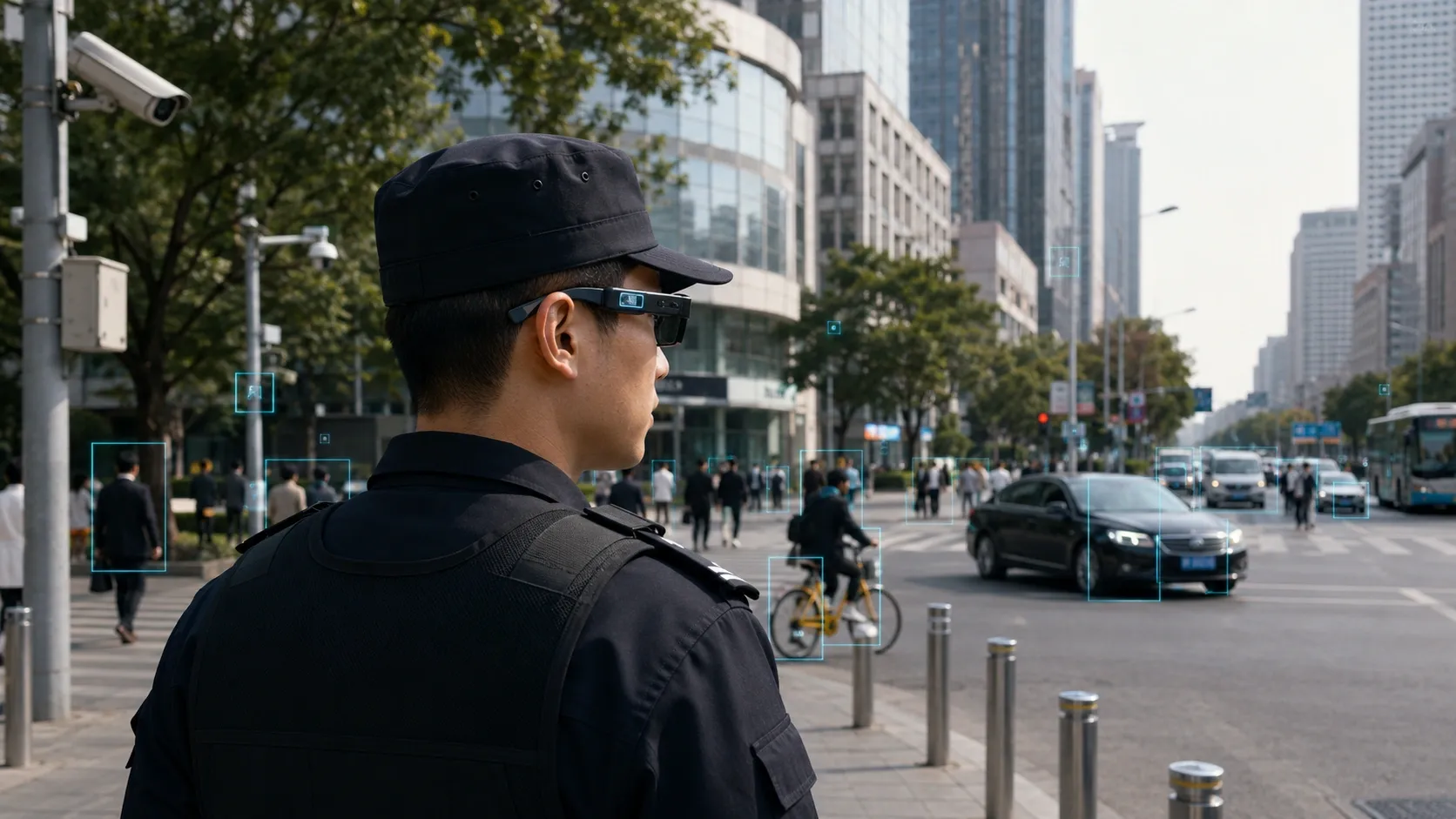
China's police in Tianjin are now wearing smart glasses that can identify anyone on the street in milliseconds. Developed entirely in-house by the Tianjin public security system, with domestic hardware and software, the glasses combine OCR visual recognition, an AI large model, and real-time database connectivity to flag license plates, signs, objects, and people's identities on the spot. Recognition accuracy sits above 95 percent, with results returned faster than the blink of an eye.
The official use cases presented by China Daily read warmly. Traffic management at school pick-up hours. Locating missing people. Patrol efficiency. One officer, Zhao Baoxin, described finding a confused elderly man who couldn't give his name or address, with the glasses identifying him and reuniting him with his family in under 20 minutes.
On one hand, that's a genuinely useful application of the technology. On the other, it confirms the glasses are running live facial recognition linked to a government identity database every single time an officer looks at someone, whether they're a lost pensioner or just a person walking to work. The glasses don't distinguish between those two situations. They just identify.
This is the same tension playing out with consumer smart glasses, where Meta's AI glasses landed under Texas biometric scrutiny after it emerged that footage was being routed for human review and facial recognition capabilities were being explored. Police-issue hardware with a direct government database connection makes that concern look modest by comparison.
When "Efficiency" Is the Infrastructure for Something Worse
The scale of what's already deployed makes the lost-grandpa framing hard to sustain. In Jinyun County, Zhejiang Province, AI glasses improved roadside vehicle checks by around 300 percent. In Haikou, Hainan Province, identification to alert now runs in under 30 seconds. In Chengdu, the glasses have been integrated with humanoid robots and robotic dogs to build what officials describe as a three-dimensional prevention and control system covering air, ground, and individual officers. Shenzhen has explicitly named AI glasses in its 2026 public security work plan.
China's public security IT market grew from 10.8 billion yuan in 2015 to 25.5 billion yuan last year, a compound annual growth rate of nearly nine percent. A national conference in December called for accelerating digital and intelligent tools across police operations. It's a funded, nationally directed buildout of wearable identification infrastructure, and the framing around elderly residents and school traffic is doing a lot of work to make that sound benign.
Once you build a system that can identify any person on any street in under a second and tie it to a government database, the application to finding lost elderly people is genuinely a feature. It's just not the only feature, and it's not the one that justified the investment.
The Pattern Spreading Beyond China's Borders
China is the most advanced deployment, but it's not operating in isolation. Delhi police used AI smart glasses for security during Republic Day celebrations in January. The Dutch national police piloted Vuzix Blade augmented reality glasses as far back as 2020. ICE in the United States is reportedly developing its own smart glasses with biometric database integration for real-time identification of people in the field. And Germany, which might not be focusing strictly on smart glasses, is building a similarly threatening biometric dragnet of its own.
The governments watching China's rollout aren't watching it as a cautionary tale. They're watching it as a proof of concept. The infrastructure being built here, with wearable cameras feeding real-time facial recognition into centralized identity databases operated by law enforcement, is the logical endpoint of how intelligence-sharing and surveillance systems have been expanding for years. China is just further along the curve and further along the curve of being open about it.
What gets called efficiency today gets called standard policing procedure in five years. It’s clear that this technology works, so the real question is who decides when it's pointed at the right person, and what oversight exists when it isn't. In China, the answer to both is the same entity that built the glasses.


Be part of the resistance, quietly.
Get Mysterium VPN
Dominykas is a technical writer with a mission to bring you information that will help you keep your digital privacy and security protected at all times. If there's knowledge that can help keep you safe online, Dominykas will be there to cover it.
Related Articles
.png)