Remember When One Subscription Was Enough?


Key Takeaways
- Streaming split across many paid apps because content owners pulled their exclusive titles off shared platforms to build their own services.
- Basic ad-supported tiers now look a lot like the cable TV that streaming was supposed to replace.
- Subscribing to five or six services can cost as much as, or more than, old cable packages.
- Shows can be deleted or moved between platforms without warning, and viewers have no say in it.
There was a time when "streaming" meant one app, one bill, and a catalog deep enough that you didn't think much about what wasn't in it. You paid once a month, you opened one icon, and the thing you wanted to watch was usually there. That's not how it works anymore.
How Streaming Got So Fragmented
Streaming fragmentation is what happens when content and audiences split across many separate paid services rather than concentrating in one place. Instead of one subscription covering most of what you want, you now need several — and each one holds a piece of the catalog hostage.
It happened for three reasons, and none of them were accidents.
- Content owners stopped licensing and started competing: For years, studios and networks made money by licensing their shows to whoever would pay for them. A single streaming service could build a genuinely deep catalog because everyone was willing to sell. Then those same content owners noticed that the platform licensing their shows was building an enormous subscriber base off that content. So they stopped selling and started their own services.
- Every major content owner wanted its own monthly fee: A licensing deal pays a lump sum. A subscription pays every month, forever, and comes with direct customer relationships and viewing data attached. Once one company proved that model worked, the incentive for every other studio was obvious. Exclusive content became the whole strategy; the reason to subscribe wasn't quality of service, it was that a specific show existed on one app and nowhere else.
- Ad-supported tiers crept back in: Streaming's original pitch included the absence of commercials. That's largely gone. Ad-supported plans are now an industry standard, and in many cases the cheapest available tier is the one with ads — meaning the default experience for a price-conscious viewer is closer to broadcast television than to what streaming originally promised.
Audience fragmentation is the flip side of the same process. As viewers scatter across a dozen platforms, no single service reaches everyone anymore. That's a problem for the industry and an annoyance for you, but it's the direct consequence of a business model where exclusivity is the product.
The Timeline: How Fast It Actually Happened
The streaming industry started nearly 20 years ago (feel old yet?), but it really hit the ground running about 10 years ago. In 2023, the industry started changing. Here’s how:
| Year | What launched or changed |
| 2007 | Netflix introduced streaming services |
| 2008 | After launching in private in 2007, Hulu finally goes public |
| 2011 | Amazon adds Prime Video as a subscription perk |
| 2013 | Netflix releases House of Cards, the first major Netflix original show |
| 2019 | Disney+ and Apple TV+ both launch, within weeks of each other |
| 2020 | Peacock and HBO Max both launch |
| 2021 | Paramount+ and Discovery+ launch |
| 2022 | Ad-supported tiers arrive at the two largest services |
| 2023 | Warner Bros. Discovery merges HBO Max and Discovery+ into one service |
The pattern is visible immediately. Between 2019 and 2021, at least six major services launched within a few years. Nearly all of them were owned by companies that had previously licensed their content to existing platforms.
That wasn't coordination. Every major content owner independently reached the same conclusion at roughly the same time: a direct subscription relationship was worth more than a licensing check.
The 2023 merger of two of those services back into one is the first visible sign of the reverse process starting. As of 2026, Disney+ now comes in a bundle with Hulu and ESPN.
What It's Actually Costing You
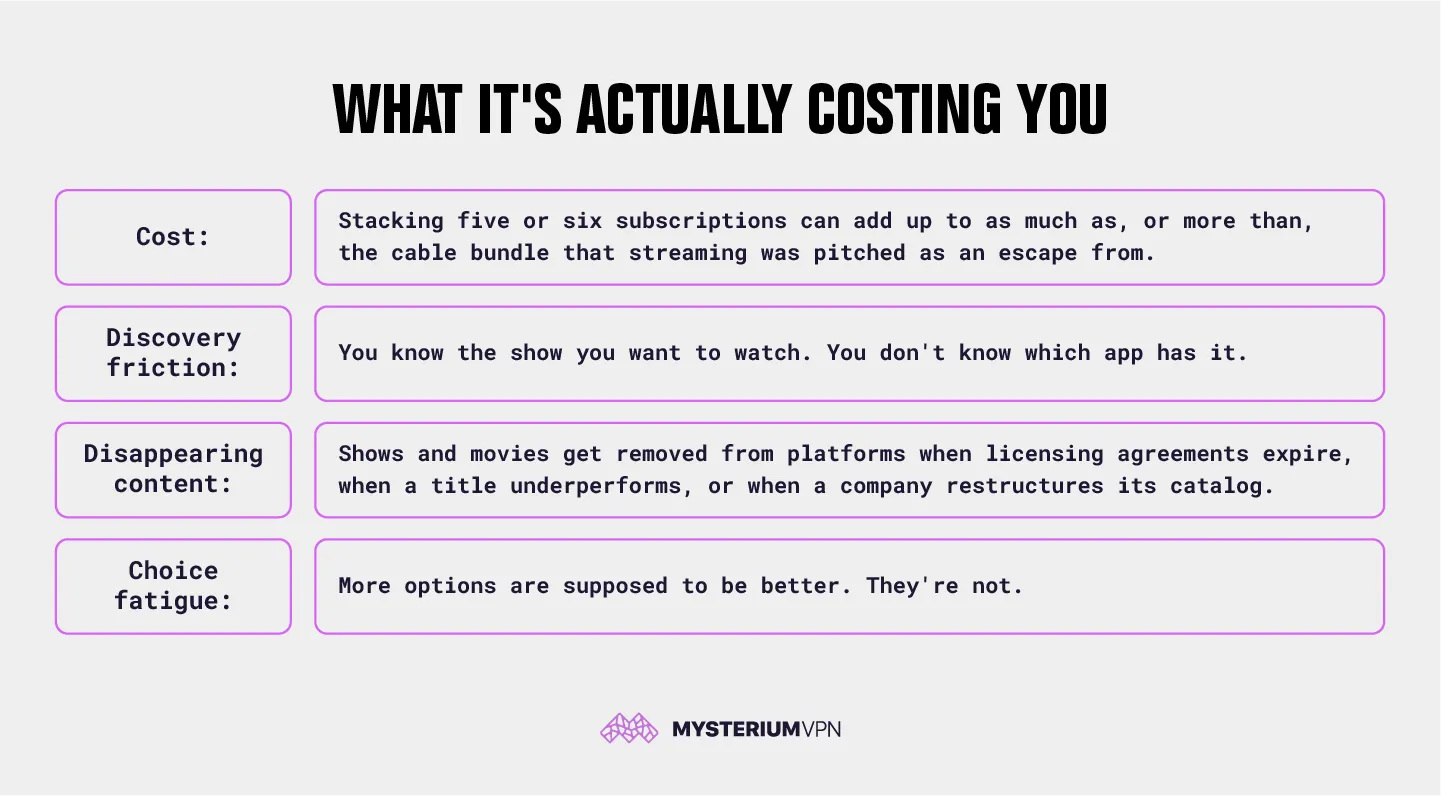
The fragmentation isn't abstract. It shows up in four specific ways.
Monetary Cost
Stacking five or six subscriptions can add up to as much as, or more than, the cable bundle that streaming was pitched as an escape from. The individual prices still look reasonable in isolation. The total doesn't. And because each service raises prices on its own schedule, the increase arrives in pieces small enough that most people don't reexamine the whole picture.
The structural reason prices keep rising is worth understanding. When one platform licensed content from many owners, production costs were spread across a shared subscriber base. When every owner runs its own service, each one carries its own production and infrastructure costs alone, with a smaller subscriber base to spread them across. Fragmentation didn't just divide the catalog. It divided the economics, and the gap gets closed by raising prices or adding advertising.
Discovery Friction
You know the show you want to watch. You don't know which app has it. So you check two or three, or you search for it, or you give up and watch something else. That's a real cost in time and attention, and it's a direct product of a catalog that's been deliberately split apart.
Disappearing Content
Beloved shows and films get removed from platforms when licensing agreements expire, when a title underperforms relative to what it costs to host, or when a company restructures its catalog for tax or strategic reasons. Viewers usually find out when they go to watch something, and it's gone. If you're partway through a series, that's the end of it.
Choice Fatigue
More options are supposed to be better. In practice, managing six subscriptions, tracking what renews when, deciding what to cancel, remembering which app has the thing you were watching, is an administrative headache that didn't exist when the model was simpler.
Streaming's original selling point was that it wasn't cable: no bundles you didn't want, no ads, no long-term contracts, no channel-surfing to find something worth watching.
Most of those problems have quietly returned in a different shape. And the tracking behind it followed the same path — a system that promised to be simpler than what came before, then rebuilt the complexity somewhere less visible.
The Price Story
Fragmentation and price increases aren't separate trends. They're the same trend.
When one platform licensed content from many owners, production costs were spread across a shared subscriber base. Every owner running its own service means each one carries its own production and infrastructure costs alone, with a smaller audience to spread them across.
That gap gets closed two ways: raising subscription prices, or adding advertising. Both happened.
What the Increases Look Like
The pattern across the industry is consistent. Services launch at an introductory price low enough to drive signups, hold it for a year or two while building a subscriber base, then raise it repeatedly once switching costs are high enough that most people stay.
| Service | Launch price (US, monthly) | Approximate current price | Increase since launch |
| Netflix (standard) | $7.99 (2011, post-DVD split) | $8.99 (with ads), $19.99 (ad-free) | $10+/mo |
| Disney+ | $6.99 (Nov 2019) | $11.99 (with ads), $18.99 (ad-free) | $10+/mo |
| HBO Max | $14.99 (ad-free plan) | $10.99 (with ads), $18.49 (ad-free) | $4+/mo |
| Apple TV+ | $4.99 (Nov 2019) | $12.99 (ad-free) | $8+/mo |
| Paramount+ | $5.99 (with ads), $9.99/mo (ad-free) | $8.99/mo (with ads), $13.99/mo (ad-free) | $4+/mo |
| Peacock | $4.99/mo (with ads), $9.99/mo (ad-free) | $12.99/mo (with ads), $19.99/mo (ad-free) | $10+/mo |
If you’re anything like me, you like watching a few shows at the same time. So, in a hypothetical scenario, you may be watching What We Do in the Shadows (Disney+, $18.99/mo), The Pitt (HBO Max, $18.49/mo), and the newest true crime documentary series on Netflix ($19.99/mo).
Not to mention the YouTube Premium ($13.99/mo) you had to get because the Mormon ads were getting ridiculous. That’s over $70/mo for streaming alone! The good news is – you’re not alone. And the industry is catching up.
Where This Might Be Headed
There are early signs the industry is reversing course, or at least trying to.
Subscription fatigue has created renewed commercial interest in both physical media (like buying DVDs and CDs and converting them into digital files to hold on your own devices), and bundles (packages that combine multiple services at a discount, like Disney+, Hulu, and ESPN), in what the industry calls super-aggregation: platforms that gather several streaming services into a single interface with unified search and billing.
The pitch is that you can find and watch everything from one place, without managing a dozen separate apps. Ironic, right? If that sounds familiar, it should.
A single interface, a bundled price, and access to content from many providers is a reasonably precise description of what cable television used to be. The industry spent fifteen years fragmenting away from that model and is now, in some way, backtracking to the way it used to be.
Whether aggregation actually reduces cost or just adds another intermediary layer isn’t settled. But the fact that it's being seriously pursued tells you that fragmentation reached a point where even the companies benefiting from it recognized the friction was becoming a problem.
Where This Goes From Here
Streaming promised to be simpler than cable, and for a while it genuinely was. One app, one bill, a catalog worth paying for.
What happened since isn't a mystery or a conspiracy. It's what happens when every content owner independently decides that the monthly subscription is a better business than the licensing deal, and the collective result is a system that costs more and works worse than the thing it replaced. Nobody set out to rebuild cable. It just turned out that the incentives pointed there.
A similar story is playing out with age verification, where a series of individually reasonable-sounding decisions accumulated into something nobody would have designed on purpose. Geoblocking is part of the same story, too — restrictions that made sense as isolated business decisions, layered until the result is an internet that behaves differently depending on where you're standing.
The fix isn't nostalgia. You can't un-fragment the streaming market by missing 2013. But it's worth noticing when a system quietly rebuilds the thing it was supposed to replace, and worth being clear-eyed about what you're actually paying for. That's the whole idea behind Nothing to Prove: you shouldn't have to justify wanting the internet to work the way it was supposed to.


Frequently Asked Questions
Gintarė is a cybersecurity writer at Mysterium VPN, where she explores online privacy, VPN technology, and the latest digital threats in editorial pieces. With hands-on experience researching and writing about data protection and digital freedom, Gintarė makes complex security topics accessible and actionable.
Related Articles