- Blog >
- Best Residential VPN: What Makes One Actually Residential?
Best Residential VPN: What Makes One Actually Residential?



Key Takeaways
- A residential VPN routes traffic through ISP-assigned household IPs rather than datacenter IPs; that's an infrastructure distinction, not a difference in protocol or app features.
- The best residential VPN provider will be transparent about IP sourcing, run a meaningfully sized node network, keep a clear no-logging policy, and not oversell streaming access.
- Mysterium VPN sources residential IPs through a decentralized network of node operators who share their real connections, rather than from a centrally owned server farm. See a detailed Mysterium VPN review here.
- A residential VPN isn't necessary for every use case; a standard VPN is often enough for basic privacy and geo-unblocking.
Most VPNs route your traffic through IP addresses registered to data centers, not homes. A residential VPN is different. Your traffic exits through IPs that ISPs assign to real households, so your traffic looks like it's coming from someone's living room instead of a server rack.
That distinction matters more on some platforms than others, and not every provider that claims "residential" actually delivers it. Some simply relabel a standard datacenter setup and hope nobody checks. Here's what to look for, and where Mysterium VPN fits in.
What Actually Makes a VPN "Residential"?
A residential VPN is one where your traffic exits through an IP registered to a real household by an ISP, not one registered to a data center or hosting provider. That's the entire distinction, and it's about infrastructure, not protocol, encryption strength, or app features. Two VPNs can use the exact same tunneling protocol and offer wildly different results on a given website, purely because of where their exit IPs are registered.
It’s a question of where the IP comes from, and providers get their residential IPs one of two ways: by operating their own ISP-registered IP blocks directly, which is expensive and hard to scale, or by sourcing IPs from a distributed network of real people who agree to share their residential connections.
The second model is how peer-to-peer or decentralized residential networks work, and it's generally the only way a smaller provider can offer meaningful geographic spread without owning IP infrastructure in every country it wants to cover.
Mysterium VPN operates on the latter model, drawing IPs from a decentralized network of node operators rather than from company-owned infrastructure. The result is a pool of exit IPs that behaves, from a website's perspective, as ordinary household traffic spread across many locations rather than a single company's server range, since each IP genuinely traces back to a real home connection rather than a data center leased in bulk. For more on how residential IPs work at a technical level, see what a residential IP address actually is.
What to Look for in a Residential VPN
Before comparing specific providers, it helps to know what actually separates a good residential VPN from one that's using the label loosely. These criteria apply to any provider making the claim, not just the one this page eventually recommends, so treat them as a checklist you can run against whichever service you're actually considering.
- IP source transparency: Does the provider clearly explain where its residential IPs come from, whether that's owned ISP blocks or a network of individual node operators? A provider that's vague about sourcing is worth treating with suspicion, regardless of how the marketing reads. This is usually the fastest way to tell a genuine residential VPN apart from one misusing the term.
- Network size and geographic spread: A larger, more geographically distributed network offers more IP options and reduces the likelihood that any single IP is overused and flagged. A tiny pool of residential IPs behaves a lot like a small datacenter block once it's been seen enough times by the same platforms.
- Logging and jurisdiction policy: A residential IP address does little for your privacy if the provider is quietly logging your activity behind it. Check the logging policy and the jurisdiction the company operates under, not just the tagline on the homepage.
- Streaming and platform compatibility: Availability varies by platform, by location, and by how recently a given IP has been flagged, so no provider can honestly guarantee access to any specific service, no matter how confident the copy on their pricing page sounds.
- Price: Residential IPs cost more to source ethically than datacenter IPs, since they rely on real people's connections rather than bulk-provisioned server racks. A "residential VPN" priced like a budget datacenter VPN is worth a second look at how it's actually sourcing its IPs, since the economics rarely work out otherwise.
None of these criteria is specific to any one provider; they're just the questions worth asking before trusting the label, and they hold up regardless of which residential VPN makes your shortlist.
Why Mysterium VPN Fits the Residential VPN Category
Here’s how Mysterium VPN holds up on each criterion:
- IP source transparency: Our residential IPs come from a decentralized network of node operators who share their real residential connections, rather than from company-owned servers.
- Network size: We offer 7,500+ residential IPs from independent node runners in more than 100 countries worldwide. The size of our network grows as more people become node runners.
- Logging policy: Mysterium VPN is designed to prioritize your privacy. We do not log your data, browsing activity, or any other information about what you do online.
- Pricing: We offer flexible pricing across three subscription plan tiers – Basic, Plus, and Pro, which come as monthly, 1-year, or 2-year options. Pro is our most popular plan, only $2.99/mo, 78% off a 2-year plan!
If you want to learn more about Mysterium VPN, our residential VPN page breaks down how it works.
When Does a Residential VPN Actually Matter?
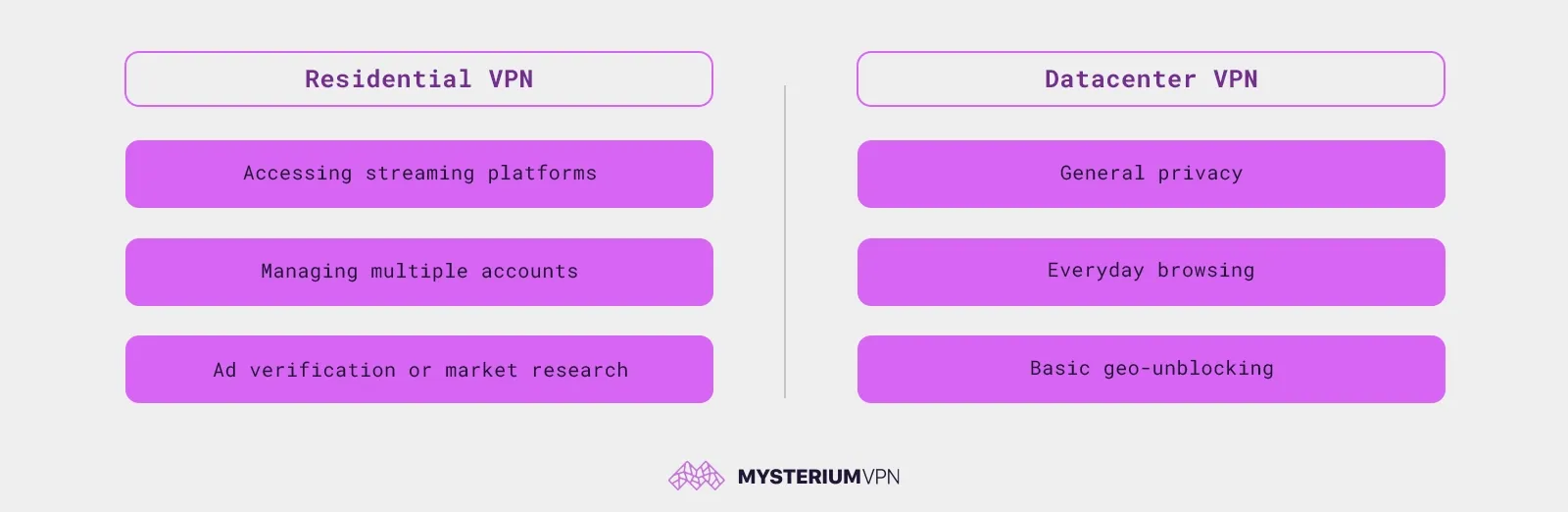
Most privacy use cases don't actually need a residential IP. Encrypting your traffic, hiding your IP from your ISP, and basic geo-unblocking all work fine on a standard datacenter VPN, and paying more for residential IPs in those cases doesn't buy you much beyond a bigger bill.
It's worth being honest about that rather than pushing everyone toward the more expensive option regardless of need, even if it means a shorter sales pitch. The right question isn't "is a residential VPN better," it's "does my specific use case actually run into the kind of detection a residential IP is built to get around?"
A residential VPN is great for:
- Accessing streaming platforms that actively flag and block known datacenter IP ranges — sports streaming services are a common example, and our guide to the best VPN for ESPN+ covers this in more detail.
- Managing multiple accounts on platforms with aggressive bot detection.
- Ad verification or market research work that needs traffic to look like organic household browsing.
A standard VPN is good for:
- General privacy from your ISP and public Wi-Fi networks.
- Basic geo-unblocking on platforms that don't aggressively filter by IP type.
- Everyday browsing, where being flagged as a VPN user isn't a meaningful concern.
Availability still depends on the platform, your location, the reputation of the specific IP you connect to, and your usage pattern, so even a residential VPN can't guarantee a specific outcome on every service.
The honest answer to "will this get me onto X platform?" is usually "probably, but it depends," which isn't as satisfying as a guarantee, but it's the more accurate option. For a closer look at how this plays out with streaming specifically, see our guide to using a residential VPN for streaming.


Reclaim the internet that took you at your word!
Get Mysterium VPN
Frequently Asked Questions
Gintarė is a cybersecurity writer at Mysterium VPN, where she explores online privacy, VPN technology, and the latest digital threats in editorial pieces. With hands-on experience researching and writing about data protection and digital freedom, Gintarė makes complex security topics accessible and actionable.
Related Articles
.png)