The Web We Lost: 2006's Top 50 Sites, 20 Years On


Key Takeaways
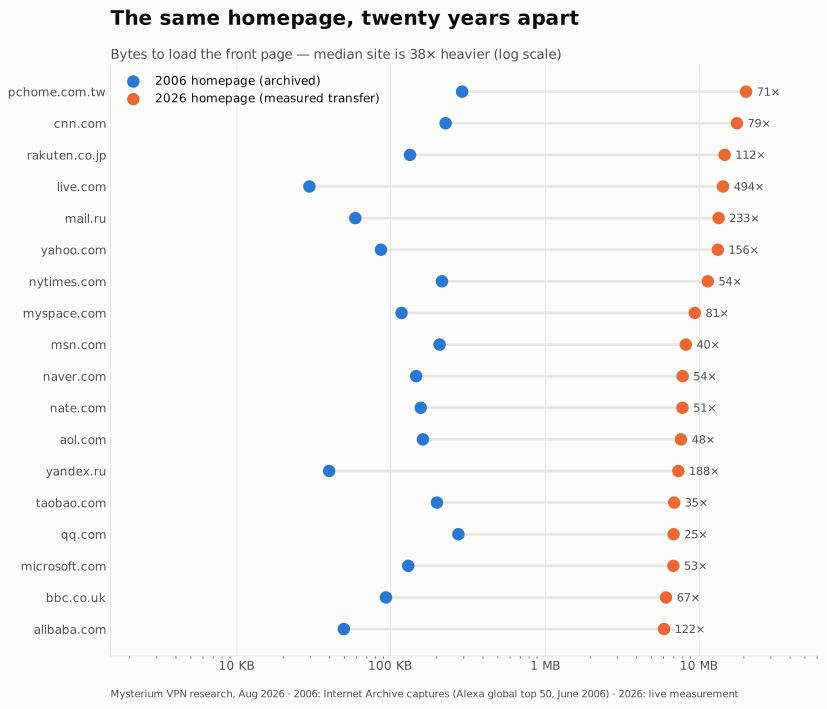
- The median homepage among 2006's 50 biggest websites is 38 times heavier today, and the mean increase is 63 times. One site grew 494-fold.
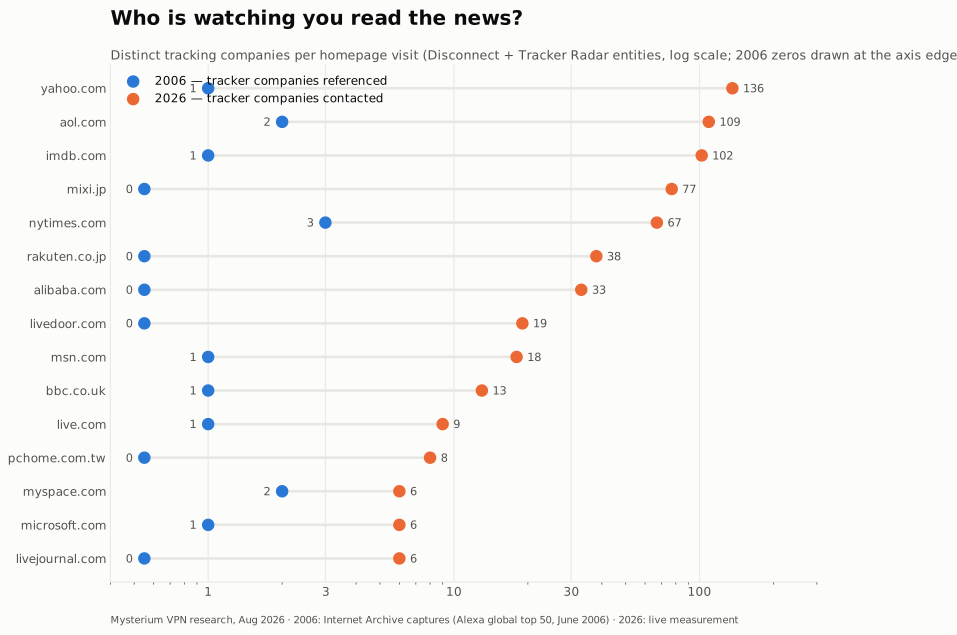
- Tracking went from exception to default: 22 of the 50 sites contacted zero tracking companies in 2006. Today only 9 do, and the average site contacts 13.
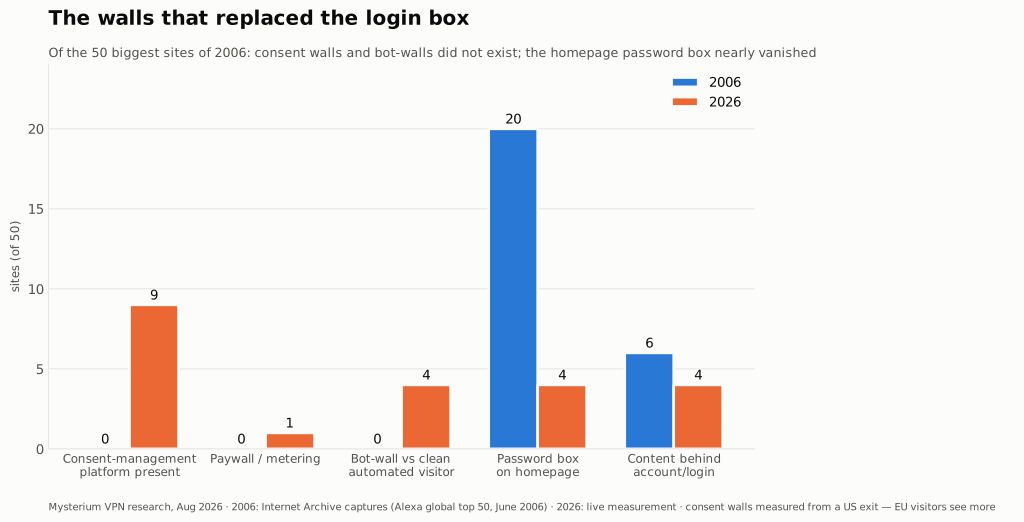
- Every wall a visitor hits in 2026 – consent banners, paywalls, bot checks – was built in the intervening twenty years. None existed in the 2006 captures.
- Login boxes actually became rarer, dropping from 20 of 50 homepages to 4. Identity didn't disappear; it moved underneath everything else.
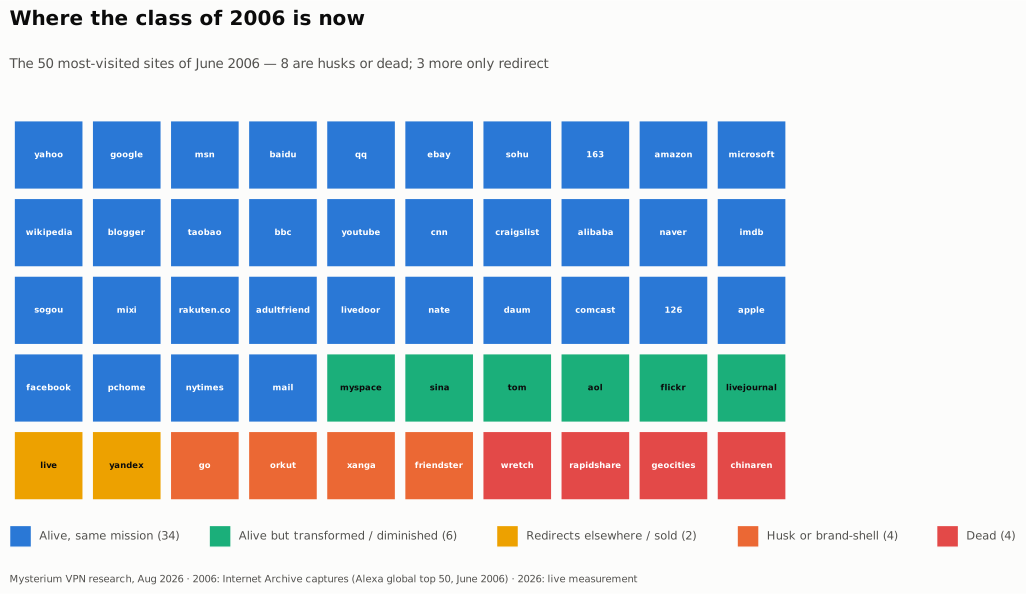
- One in five of 2006's biggest websites no longer exists as itself.
In June 2006, Yahoo's homepage was the most-visited page on the internet. It weighed about 90 kilobytes, made roughly eighteen requests, and told one tracking company about the visit.
The same page today ships more than 13 megabytes, fires over two thousand requests, sets 326 cookies, and shares the visit with 136 separate tracking companies.
That isn't an outlier. It's what happened to the entire class of 2006.
Mysterium VPN's research team took the 50 most-visited websites on Earth as ranked by Alexa in June 2006 – the actual archived ranking page, captured on June 10, 2006 – and measured each one twice with the same instrument. Once as its homepage existed in late June 2006, via Internet Archive captures. Once as it exists in August 2026, via live measurement in a clean browser with full network capture.
The result is a dataset where every nostalgic feeling about the old web becomes a number.
The Numbers
| Metric | 2006 | 2026 |
| Median homepage weight | 114 KB | 3.5 MB (38× heavier; mean 63×) |
| Median requests per page | 29 | 153 |
| Tracker companies per visit (mean) | 0.7 | 13.4 |
| Tracker companies per visit (worst) | 3 (NYT, mail.ru) | 136 (Yahoo) |
| Sites contacting zero tracker companies | 22 of 50 | 9 of 50 |
| Median third-party domains contacted | 1 | 9.5 |
| Median cookies on a first visit | n/a (a handful) | 15 (Yahoo: 326) |
| Consent-management platforms | 0 of 50 | 9 of 50 (US view; EU sees more) |
| Paywalled | 0 | NYT metered (plus regwall history) |
| Bot-walls against a clean automated visitor | 0 | 4 of 50 |
| Password box on the homepage | 20 of 50 | 4 of 50 |
| Gone, husk, or brand-shell | — | 8 of 50 (+2 redirect elsewhere) |
All 2006 figures from archived homepages (nearest capture to 2006-06-30); all 2026 figures from live measurement Aug 22nd–23rd, 2026, median of up to three visits.
The Page Got Heavy
The median 2006 top-50 homepage — HTML plus every image, script and stylesheet it referenced — weighed 114 KB. Google’s was 2.4 KB of HTML referencing a single logo.
The median 2026 homepage transfers 3.5 MB on a first visit, and the top of the range has left the old web three orders of magnitude behind: CNN at 17.6 MB, Taiwan’s PChome at 20 MB, Rakuten at 14.6 MB. live.com — an 11 KB Microsoft login stub in 2006 — now redirects to a 14 MB Outlook marketing page, a 494× increase.
This matches the whole-web trend in HTTP Archive’s public dataset (median desktop page: 468 KB in Nov 2010, first year measured, to 3.0 MB in Aug 2026), but the top-50 cohort shows it happening to the exact pages people remember.
Surveillance Became the Default
In 2006, 22 of the 50 homepages referenced no known tracking company at all. The typical tracker of that era was a lone hit counter or Google’s newly acquired Urchin Analytics; the most-surveilled homepage in the cohort (NYTimes) referenced four tracking domains — three companies by today’s ownership map.
In 2026, the average site in the same cohort talks to 13 tracking companies on a fresh visit with no consent given, and the ad-funded portals talk to a hundred or more: Yahoo 136, AOL 109, IMDb — an Amazon property — 102. Even Japan’s mixi, invitation-only and tracker-free in 2006, now contacts 77. Cookie counts tell the same story: a first visit to Yahoo sets 326 cookies, 300+ of them third-party.
A note on fairness: tracker classification lists are Western-centric, so Chinese portals’ counts are understated — their third-party ecosystems are measured but less often classified as trackers. The cross-market metric (third-party domains contacted: median 1 then, 9.5 now) carries no such bias. Both are in the dataset.
New Walls, in Order of Appearance
Nothing resembling a consent banner exists in any of the fifty 2006 captures — the phrase “accept all cookies” appears nowhere in 2.5 megabytes of archived front-page HTML. The stack of walls a visitor can hit in 2026 is entirely new: consent-management platforms on at least 9 of 50 (OneTrust, Sourcepoint, TrustArc, Osano and peers — a US-vantage floor; EU visitors see the banners these platforms exist to serve), a metered paywall where a registration wall once stood at the NYT, and — the newest species — the bot-wall.
Four of the fifty (eBay, Flickr, LiveJournal, Comcast) refused our clean datacenter browser outright; we re-measured three of them from a real household browser in the EU. Two more (Sina, ChinaRen) no longer answer non-Chinese visitors at all.
One in Five Is Gone
Eight of 2006’s fifty biggest sites are dead or reduced to husks, and two more survive only as redirects. GeoCities (rank 37 in 2006) is gone. Wretch, Taiwan’s photo-blog giant, is gone. RapidShare is gone. Orkut’s domain serves its founder’s farewell letter. Xanga is frozen mid-relaunch since 2013.
Friendster’s name was bought by an unrelated app this year. Go.com is a Disney placeholder. live.com redirects to an Outlook sales page; yandex.ru now lands on dzen.ru, its news business having been sold. LiveJournal — the blogging home of the mid-2000s English-speaking web — survives, but as a Russian property whose front page loads Rambler, Sber and VK ad-tech.
Why the Numbers Matter
The bloat is the visible symptom. The tracking is the mechanism underneath it.
A page doesn't grow from 114 KB to 3.5 MB because the content got 30 times richer. It grows because each visit now triggers an auction, and the infrastructure that runs the auction – the trackers, the identity resolution, the consent management required to make it legal – ships with the page.
The 38-fold weight increase and the 19-fold increase in tracking companies are the same finding measured two ways.
That has a practical cost beyond privacy. Heavier pages load slower on older devices and cost more on metered connections, which means the surveillance layer is paid for disproportionately by people on cheap hardware and expensive data.
The consent banners were supposed to fix the consent problem. Measured from the US, they appear on 9 of 50 sites – and the tracking happens on 41 of 50 regardless.
Methodology
Cohort
The 50 most-visited distinct websites in the world in June 2006, taken from the Alexa Global Top 500 page as captured by the Internet Archive on June 10th, 2006. This is the primary source, not a reconstruction. Regional mirrors of an already-ranked property – 11 Google country domains, 3 eBay, 2 Yahoo – were collapsed into the parent. Five ad-serving and login-infrastructure entries were excluded and documented in the dataset.
2006 Measurement
For each site, the raw archived homepage HTML nearest to June 30th, 2006, was fetched from the Wayback Machine in original form. All captures fall between June 1st and July 13th, 2006. Page weight adds the archived transfer sizes of up to 35 referenced subresources per page, covering 1,105 resources in total. Trackers, third parties, consent signals, and login signals come from static analysis of that HTML.
2026 Measurement
Live homepage loads in a fresh headless Chromium profile at 1366×900, en-US, US network exit, with no prior cookies. Full network capture via Chrome DevTools Protocol recorded every request and its on-the-wire transfer size, all cookies, visible consent UI, login walls, and bot challenges. Results are the median of up to three independent visits.
Identical Instrument
The same parser scored both eras' HTML. The tracker map covers 4,951 domains resolving to 1,928 companies, combining the Disconnect tracking-protection list with DuckDuckGo Tracker Radar.
Hand-coded judgments about site status and content gating are kept separate from measured fields, each with written evidence.
Limitations
Archived 2006 pages under-report dynamic third-party behavior, so 2006 tracking figures are generous to 2006 – the direction that makes the 2026 comparison conservative. 2006 page weights are lower bounds, since 12% of referenced resources had no in-window archived copy.
The 2026 consent-wall count is a US-vantage floor. Tracker lists under-classify Chinese ad-tech. Three sites measured from a household browser via the Performance API under-report cross-origin bytes and are flagged per-row.
What the Class of 2006 Became
Twenty years is long enough that the change feels like weather – something that happened to the web rather than something the web was made to do.
The measurements argue otherwise. A page doesn't gain 3.4 megabytes by accident, and a homepage doesn't go from one tracking company to 136 through drift. Each addition was a decision someone made, justified by a business case, shipped in a release.
What the cohort shows is that those decisions converged. Fifty sites with different owners, different countries, and different business models all arrived at roughly the same architecture: heavy pages, embedded auctions, consent infrastructure to make the auctions legal, and bot walls to protect the whole arrangement from being measured too closely.
The old web wasn't better because the people building it were more principled. It was lighter because the machinery for monetizing attention at this scale hadn't been built yet.
It has been now. That's the finding.


Be part of the resistance, quietly.

Gintarė is a cybersecurity writer at Mysterium VPN, where she explores online privacy, VPN technology, and the latest digital threats in editorial pieces. With hands-on experience researching and writing about data protection and digital freedom, Gintarė makes complex security topics accessible and actionable.