"Pervert Glasses": Norway Moves to Regulate Camera Wearables


Key Takeaways
- Norway's digital minister Karianne Tung has said the government is considering regulating or banning camera-enabled wearables such as smart glasses from Meta and Snap, citing privacy concerns about covert surveillance in public spaces.
- The move follows Germany's HateAid filing a criminal complaint against Meta, Ray-Ban, and Oakley in August, arguing that the glasses' sale in Germany constitutes a criminal offense under privacy law.
- Norway's minister specifically flagged the combination of AI with cameras and microphones built into everyday objects as a trend requiring urgent policy attention — including a potential ban on using facial recognition of other people in public spaces.
- An expert advisory group will be established to advise the Norwegian government on how to better protect people's privacy rights in light of these technologies.
Norway's digital minister Karianne Tung has announced the government is looking to regulate camera-enabled wearable devices — including smart glasses from Meta and Snap — citing privacy concerns about their use to monitor people in public spaces, according to reporting by TechCrunch.
The country is considering measures that could include banning the use of facial recognition of other people in public places, and will establish an expert advisory group to recommend how to protect privacy rights in light of these technologies.
"There is a clear trend toward combining artificial intelligence with cameras and microphones built into glasses, headphones, hats and other objects we use in everyday life," Tung said. "We must prevent this equipment from being used to monitor other people in public places."
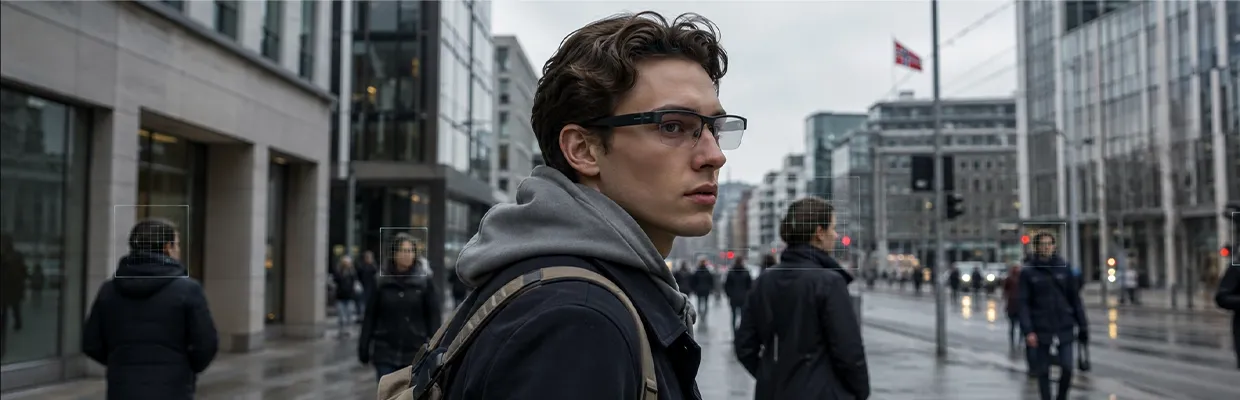
The devices in question (already dismissed by critics in multiple countries as "pervert glasses") are consumer smart glasses capable of recording video and audio, potentially feeding that content to cloud servers, and increasingly being marketed with features that inch toward real-time identification of people in the wearer's field of view.
The backlash has been building across Europe and is now producing regulatory responses.
Germany Has Already Filed a Criminal Complaint
Norway isn't moving in isolation. We covered this in August: Berlin-based non-profit HateAid filed a criminal complaint against Meta, Ray-Ban, Oakley, and several retailers, arguing that selling Meta's smart glasses in Germany constitutes a criminal offense under the country's Telecommunications, Digital Services and Data Protection Act.
The complaint centers on the same core concern Tung is raising: the glasses allow wearers to covertly film people without their knowledge, and an LED indicator light that most passersby don't recognize doesn't constitute meaningful notice.
Meta's position in the Germany case — that the glasses were approved by German regulators in 2022 and include safeguards that go beyond what smartphones offer — is the same line the company is likely to take in Norway.
The LED light argument is the central technical dispute: does a small indicator on consumer eyewear provide the kind of genuine, practical notice that privacy frameworks require?
Europe's privacy regulators have commissioned a report on smart glasses due to be finalized this summer. The simultaneous regulatory pressure from Germany (criminal complaint), Norway (potential ban), and the EU-level regulatory review suggests that report is landing in a political environment that's already decided these devices are a problem — the question now is what form the response takes.
The Pattern Behind the "Pervert Glasses" Label
The dismissive nickname exists for a reason. The concern isn't primarily about recorded video — it's about what that video enables when combined with AI.
A pair of smart glasses capable of running facial recognition in real time doesn't just record what's in front of the wearer. It identifies the people in the frame, potentially without any of them knowing they've been scanned.
We've covered this trajectory in the context of fixed surveillance infrastructure — real-time facial recognition on the London Underground, AI facial recognition in Moscow that led to a teenager being beaten by police after a misidentification.
Consumer smart glasses represent the mobile, civilian version of the same capability: surveillance infrastructure worn by private individuals, distributed across millions of devices, operating without the nominal oversight frameworks that apply to law enforcement deployments.
That's the specific concern Tung is naming: not just that the glasses can record, but that combining AI with cameras embedded in ordinary consumer objects creates a qualitatively new surveillance environment in public spaces.
A regulation banning facial recognition of other people in public places would address the most alarming near-term application without necessarily prohibiting the devices entirely.
Whether Norway moves toward an outright ban or a more targeted regulation, the direction is clear — and it's the same direction Germany, the EU regulators, and a growing number of privacy advocates are heading.
The question of who gets to put AI-powered cameras in public spaces, under what conditions, with what disclosure requirements, is one that governments are increasingly unwilling to leave to product marketing teams to answer.


Be part of the resistance, quietly.
Get Mysterium VPN
Gintarė is a cybersecurity writer at Mysterium VPN, where she explores online privacy, VPN technology, and the latest digital threats in editorial pieces. With hands-on experience researching and writing about data protection and digital freedom, Gintarė makes complex security topics accessible and actionable.
Related Articles
.png)