What is a Decentralized VPN? Understanding Its Benefits and Challenges



Key Takeaways
- Decentralized VPNs (dVPNs) use peer-to-peer networks instead of centralized servers, reducing single points of failure and centralized control.
- They offer stronger censorship resistance, making them harder for ISPs or governments to block.
- Multi-node routing and residential IP options can improve anonymity and reduce detection risks.
- Blockchain-based systems often power payments and transparency within dVPN ecosystems.
- While traditional VPNs may offer more stable speeds, dVPNs prioritize privacy, decentralization, and user empowerment.
In the world of online privacy, the terms "VPN" and "decentralized VPN" (dVPN) often come up in conversations about keeping your digital footprint safe.
With the constant rise in internet threats and surveillance, users are increasingly seeking better ways to protect their online activities. But which solution is the best? A traditional VPN or a decentralized one?
In this Mysterium VPN article, we’ll dive deep into what exactly a decentralized VPN is, its advantages and challenges, and how it differs from its traditional counterpart.
What’s a Decentralized VPN (dVPN)?
A decentralized VPN (dVPN) is a privacy tool that routes your internet traffic through a distributed network of independently operated nodes rather than servers owned by a single company.
Instead of relying on one provider’s infrastructure, a dVPN leverages a peer-to-peer (P2P) system where individuals or organizations contribute bandwidth. This structure reduces centralized control and increases resistance to censorship, while still providing encrypted browsing similar to a traditional VPN..
Key Aspects of Decentralized VPNs
Decentralized VPNs (dVPNs) run on distributed, peer-to-peer infrastructure instead of company-owned servers. Key aspects include:
- Peer-to-peer network: Traffic is routed through independent nodes run by users, not centralized servers.
- No single point of control: No single company owns or controls the entire network, increasing censorship resistance.
- Blockchain-based incentives: Many dVPNs use tokens or cryptocurrency to reward node operators and automate payments.
- Marketplace model: Users buy bandwidth from node operators in a supply-and-demand system.
- Greater censorship resistance: Harder for governments or ISPs to block compared to centralized VPNs.
- Variable performance: Speeds and reliability can differ depending on the quality of available nodes.
In short, decentralized VPNs remove central authority, distribute infrastructure globally, and often use blockchain to power a user-driven bandwidth economy.
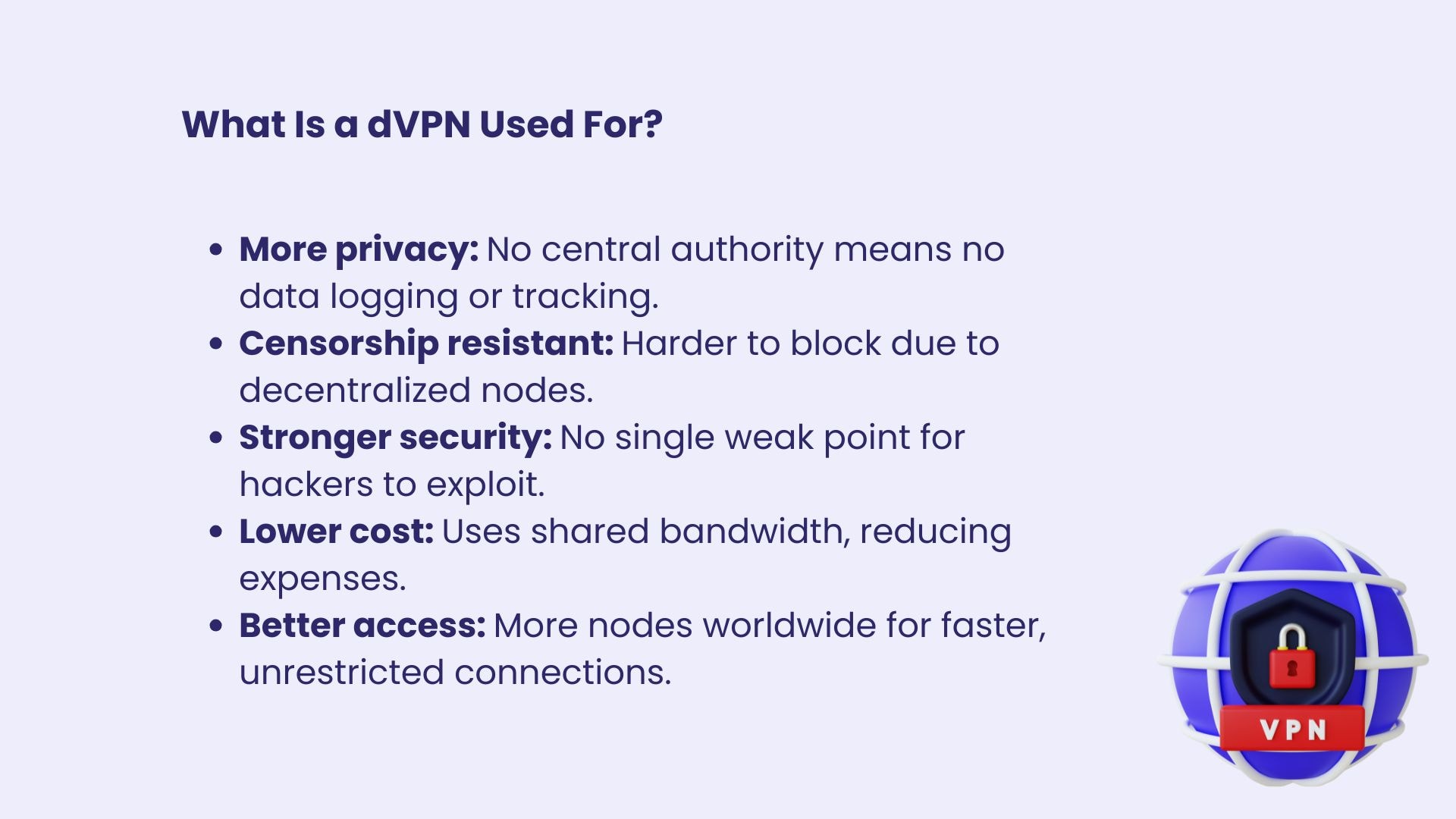
What is a dVPN Used For?
So, why would anyone opt for a decentralized VPN instead of a traditional one?
Improved Privacy
One of the key reasons users choose a decentralized VPN over a regular VPN is enhanced privacy. In traditional VPN setups, all user traffic is routed through centralized servers managed by a single provider.
While this offers some privacy protections, the provider still has access to your data and can potentially log or share it with third parties.
In contrast, decentralized VPNs (dVPNs) operate without a central authority. This means no single party is controlling or monitoring the network, reducing the chances of your data being collected or misused.
Moreover, because dVPNs are built on a peer-to-peer (P2P) network of independent nodes, your traffic is mixed with that of other users, further enhancing your anonymity.
Each connection is unique and has less of a “signature” than traditional VPN routes, so it’s harder for hackers or surveillance agencies to correlate data or track patterns.
Censorship Resistance
In many parts of the world, access to certain websites or online platforms is restricted or blocked due to government censorship or corporate restrictions.
While traditional VPNs can help bypass these firewalls, they still face the risk of being blocked themselves, especially when they rely on centralized servers.
A decentralized VPN, however, is far more resilient to censorship. Since the infrastructure is distributed across multiple nodes globally, there’s no single point of failure that authorities can target.
If one or more nodes are blocked or taken down, the decentralized nature of the network ensures that the rest of the network remains functional.
This makes dVPNs an excellent choice for users in countries with strict censorship laws, as they can bypass restrictions without relying on a single provider, which could be easily identified and restricted.
Additionally, the decentralized network’s structure makes it much harder for governments to monitor or control users' internet traffic.
Peer-to-Peer Security
The decentralized VPN model leverages a peer-to-peer (P2P) structure, where users around the world contribute their unused bandwidth to help route internet traffic.
This structure offers a unique advantage in terms of security. In traditional VPNs, all traffic flows through a central server, which is a potential weak point that hackers or other malicious actors could target.
On the other hand, with decentralized VPNs, your internet connection is routed through multiple nodes, making it much harder for any single entity to compromise the entire network. This means the security of the network is distributed, and no one node or entity has complete control over the traffic.
Furthermore, because the nodes in a decentralized VPN are residential IP addresses rather than data centers, the network’s footprint is less predictable and more difficult for hackers or surveillance agencies to target.
The P2P structure also adds a layer of unpredictability to the routing, which makes it more challenging to track users based on their traffic patterns.
As a result, decentralized VPNs offer stronger security through diversification and redundancy, ensuring that your connection is more resilient to potential breaches.
Cost-Efficiency
Another major benefit of decentralized VPNs is their cost-effectiveness. Traditional VPN providers typically need to maintain and manage large centralized infrastructure, which can be expensive.
The provider must purchase and maintain servers in multiple countries, invest in data encryption technologies, and continually scale their infrastructure to meet the growing demand for bandwidth. These operational costs are often passed on to users in the form of subscription fees.
In contrast, decentralized VPNs operate using a P2P model, where users contribute their unused bandwidth to the network. This allows the decentralized VPN to spread the costs of operating the network across many participants.
By distributing the workload and not relying on expensive server farms, dVPNs can often provide more affordable services. This peer-to-peer approach also allows users to share the cost of bandwidth while benefiting from secure, private internet access.
Accessibility and Global Reach
Decentralized VPNs also offer a global network of nodes, which increases accessibility and helps ensure that users can always find a node nearby for faster connection speeds.
Since dVPNs rely on a distributed server network, users can connect to nodes in virtually any location, even if their country has a limited number of traditional VPN servers.
In traditional VPNs, users are limited to the servers the provider offers, which may not always be in the locations they need. With a decentralized VPN, the diverse array of nodes gives you more flexibility and a greater ability to access content worldwide.
Moreover, because the network is distributed, decentralized VPNs are often better equipped to maintain availability in areas where internet service providers (ISPs) may block traditional VPN traffic.
The global network of nodes also makes it easier for users to avoid throttling or interference from their ISP, which can sometimes slow down traditional VPN services.
Decentralized Nature Promotes Freedom
Beyond privacy and cost, decentralized VPNs embody a larger shift in the digital landscape. They offer a step toward more decentralized and autonomous internet access, aligning with a growing movement toward internet freedom and user control.
In an era of increasing surveillance and centralization of data, the decentralized model empowers individuals to reclaim their online privacy and take control of how their data is used.
Instead of relying on a single centralized provider that could potentially sell or misuse user data, decentralized VPNs give power back to the users, offering them greater control over their own internet experience.
As digital freedoms continue to be eroded in some regions of the world, dVPNs represent a form of resistance against censorship and surveillance, allowing users to break free from restrictive internet controls.
Comparison: dVPN vs. Traditional VPN
While both VPNs and decentralized VPNs aim to provide enhanced privacy and security, they are quite different when it comes to the underlying technology. Here’s how they compare:
Centralized vs. Decentralized Control
Traditional VPNs are typically managed by a single service provider. They control the infrastructure, which can introduce risks like data breaches or centralized surveillance.
Decentralized VPNs, on the other hand, are powered by multiple nodes spread across the globe, so there’s no central authority overseeing the network.
Routing of Traffic
In a traditional VPN, all internet traffic is routed through a central server. In a decentralized VPN, traffic is routed through various nodes in the network, creating a more distributed routing system.
Security Risks
While regular VPNs are generally secure, they still face risks like data breaches or central server attacks. Decentralized VPNs operate on blockchain technologies, providing a more secure, tamper-resistant system for routing traffic.

Is a Decentralized VPN Safe?
Yes, dVPNs are safe and provide significant privacy advantages. Their decentralized nature means there's no central authority or server that could be compromised.
Traffic is routed through multiple nodes across the globe, making it harder for malicious actors to track or access your data. Many dVPNs operate with a "no logs" policy, ensuring that no personal data is stored.
Additionally, the use of peer-to-peer connections and blockchain technology strengthens encryption and transparency, offering a higher level of security compared to centralized VPNs.
Are Decentralized VPNs Legal?
Decentralized VPNs are legal in most countries, as they function similarly to traditional VPN services. However, the legality depends on local laws regarding online privacy and censorship.
In some countries with strict internet control, using any VPN, including dVPNs, may be restricted or illegal. Despite this, dVPNs are generally allowed in regions where privacy is protected.
It's essential to be aware of the laws in your country before using any VPN service, as engaging in illegal activities with a VPN remains unlawful regardless of the technology used.
How Does a Decentralized VPN Work?
A decentralized VPN relies on a network of distributed nodes rather than a central server. Users who contribute unused bandwidth allow their IP addresses to act as nodes for routing internet traffic.
Blockchain technology is often used to maintain transparency and secure transactions within the network, ensuring that no one can tamper with the data being passed around.
The decentralized structure provides inherent privacy because there’s no central server collecting logs. Data encryption, combined with the routing of traffic across multiple nodes, further enhances privacy.
Security and Safety of VPN vs. dVPN
Here's a comparison of the security and safety features of both types of networks:
Traditional VPN
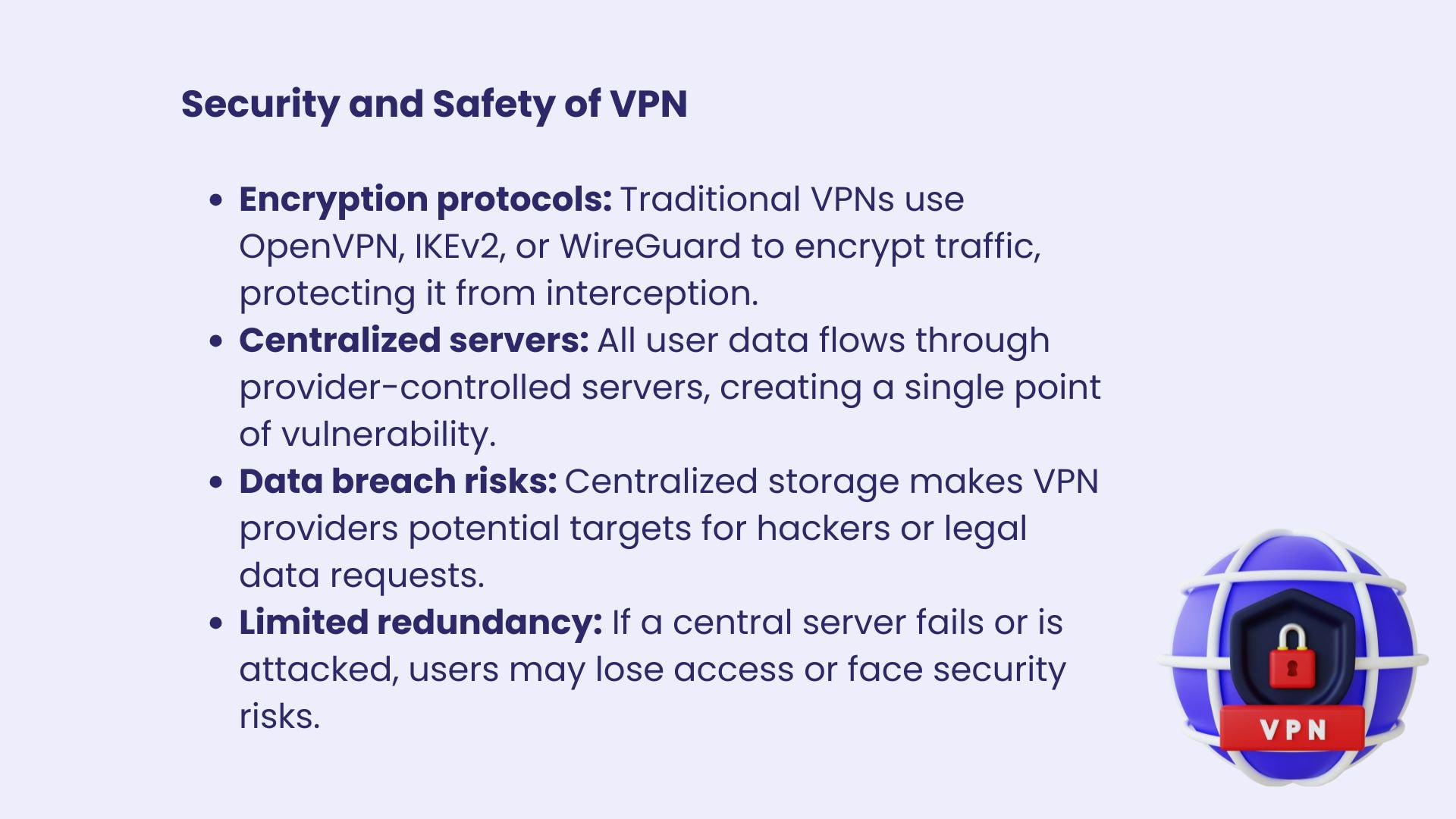
Here's how a centralized VPN service provider makes sure you're safe and sound.
Encryption Protocols
Traditional VPNs use encryption protocols such as OpenVPN, IKEv2, or WireGuard to protect data as it travels over the internet. These protocols ensure that your information is scrambled, making it unreadable to anyone who tries to intercept it.
Centralized Servers
Centralized VPNs route your traffic through servers managed by a single VPN provider. While these servers are generally secure, they remain a potential point of vulnerability. If the provider’s central server is compromised or hacked, all the user data passing through it could be exposed.
Risk of Data Breaches
Since the provider controls the servers and may collect user data (depending on their privacy policy), there’s always the risk of a breach.
Centralized data storage can be a target for hackers, and the provider could potentially be compelled to hand over user data if required by law enforcement or other authorities.
Limited Redundancy
With a centralized VPN, if something goes wrong with the server (e.g., it gets attacked or goes offline), it could disrupt your connection or compromise your privacy. There's no backup system outside of the provider's infrastructure, making your security more dependent on one point of failure.
dVPNs (Decentralized VPNs)
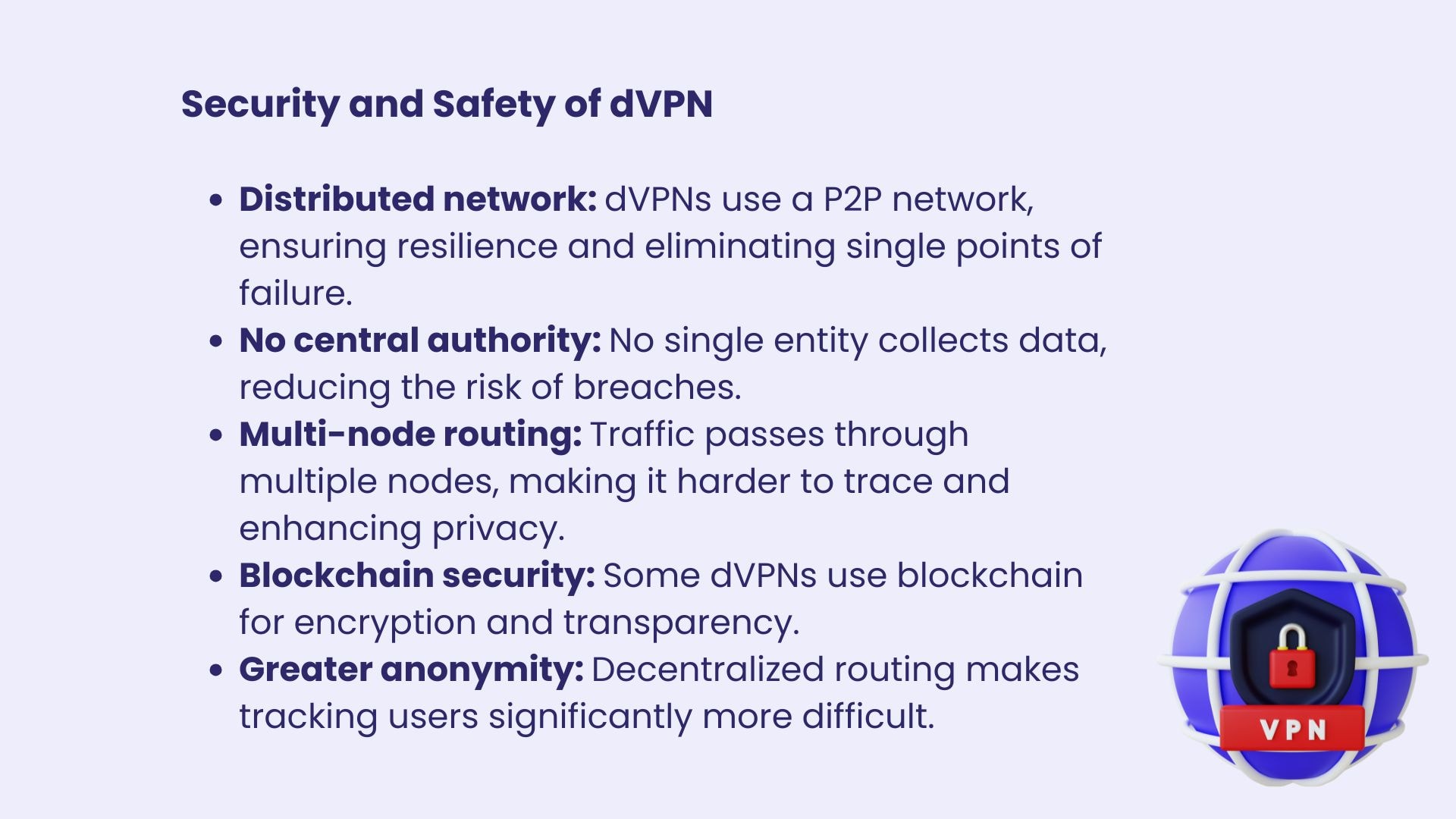
Now, let's take a look at the safety and security features of a decentralized VPN.
Distributed Network Structure
A decentralized VPN works on a peer-to-peer (P2P) network, where multiple independent nodes contribute to routing traffic. This distributed structure means there’s no central server that can be compromised.
If one node is taken down or attacked, the rest of the network can still function normally, ensuring greater resilience and redundancy.
No Central Authority
Since there’s no central authority overseeing the network, decentralized VPNs are not susceptible to the same risks as centralized VPNs. There’s no single entity collecting user data, so the chances of a data breach are much lower.
This reduces the risk of exposing personal information to hackers or being forced to comply with legal data requests.
Multi-Node Routing
Traffic in a decentralized VPN is routed through multiple nodes, making it harder for any malicious actor to trace your activity. Each node in the network only knows the data it handles and not the complete route of the traffic, which increases your privacy and security.
The P2P structure ensures that no one has a full picture of your online activity.
Blockchain and Encryption
Many decentralized VPNs integrate blockchain technology to add an extra layer of security and transparency. Blockchain allows users to verify transactions and ensures that the data being transferred is protected by robust encryption methods.
This technology also prevents any central authority from tampering with the network or its data.
Increased Anonymity
By routing traffic through multiple decentralized nodes, dVPNs make it more difficult for third parties to monitor or track your internet activity.
Even if one node is compromised, it’s much harder for hackers to follow the entire trail back to the user, making dVPNs a safer option for those seeking enhanced anonymity.
How to Choose the Right VPN Provider for You
So, should you opt for a regular VPN or a decentralized VPN? The answer depends on your needs.
- Privacy and anonymity: If you're looking for an enhanced level of privacy with fewer risks of data breaches, a decentralized VPN is the way to go.
- Bypass censorship: If you live in a country with heavy internet censorship, decentralized VPNs offer better resistance to censorship compared to traditional VPNs.
- Speed vs. security: Traditional VPNs generally offer better speeds due to the infrastructure they have in place. However, decentralized VPNs may have variable speeds depending on the network, but the added security may make the trade-off worthwhile for some users.
Mysterium VPN: Not a Conventional VPN
If you’re looking for a VPN that goes beyond the traditional centralized model, Mysterium VPN offers a decentralized alternative built for stronger privacy, censorship resistance, and flexibility.
Unlike conventional VPN providers that rely on company-owned servers, Mysterium operates on a distributed network where users can act as nodes — both providing and accessing secure internet bandwidth. This peer-to-peer structure removes the need to trust a single central authority and increases resilience against shutdowns or centralized surveillance.
Because the network is powered by real users, Mysterium also provides access to residential IP addresses, not just data center IPs. Residential IPs can be harder to detect and block, making them useful for bypassing strict network restrictions and accessing geo-restricted content more reliably.
You can currently get Mysterium VPN with up to 78% off, making privacy and residential IP access more affordable than ever.
With blockchain-based transactions ensuring transparency and a globally distributed infrastructure reducing central control, Mysterium VPN is built to maximize privacy, resilience, and user empowerment in today’s increasingly restricted internet landscape.


Reclaim the internet that took you at your word!
Get Mysterium VPN
Frequently Asked Questions
Gintarė is a cybersecurity writer at Mysterium VPN, where she explores online privacy, VPN technology, and the latest digital threats in editorial pieces. With hands-on experience researching and writing about data protection and digital freedom, Gintarė makes complex security topics accessible and actionable.
Related Articles
.png)